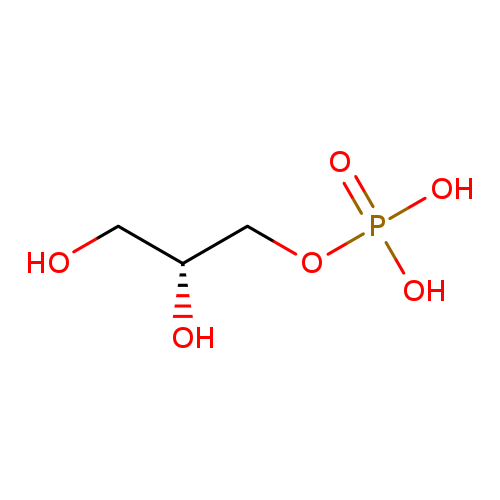
Glycerol 3-phosphate is a chemical intermediate in the glycolysis metabolic pathway. It is commonly confused with the similarly named glycerate 3-phosphate or glyceraldehyde 3-phosphate. Glycerol 3-phosphate is produced from glycerol, the triose sugar backbone of triglycerides and glycerophospholipids, by the enzyme glycerol kinase. Glycerol 3-phospate may then be converted by dehydrogenation to dihydroxyacetone phosphate (DHAP) by the enzyme glycerol-3-phosphate dehydrogenase. DHAP can then be rearranged into glyceraldehyde 3-phosphate (GA3P) by triose phosphate isomerase (TIM), and feed into glycolysis. The glycerol 3-phosphate shuttle is used to rapidly regenerate NAD+ in the brain and skeletal muscle cells of mammals (wikipedia).
belongs to the class of organic compounds known as glycerophosphates. Glycerophosphates are compounds containing a glycerol linked to a phosphate group.
Specifically, when comparing successful and unsuccessful donors on the day of FMT (D-0-success vs D-0-failure), 65 potential metabolites with a VIP score [32] > 1 were identified from the PLS-DA model (Additional file 2: Dataset S2); the top 15 metabolites, including dihydroxyacetone phosphate, glucose 6-phosphate, and glycerol 3-phosphate, are shown in Fig. 4b.
Written in the paper as “glycerol 3-phosphate” and “feces”
In dairy cows, the glycerol backbone of TAG emerges from an elegant metabolic process: glucose, forged from rumen-derived propionate through hepatic gluconeogenesis, transforms into glycerol-3-phosphate within the mammary gland, uniting with FAs to craft the triacylglycerols that define milk fat [5].
Written in the paper as “glycerol-3-phosphate” and “mammary gland”
It is significantly reduced in CM and SCM milk, which is mainly due to the destruction of the cell membrane of the mammary tissue and the action of phospholipase and carboxylesterase [80].
Written in the paper as “D-glycerol 1-phosphate” and “mastitis”
The chemical reactions and pathways involving glycerophospholipids, any derivative of glycerophosphate that contains at least one O-acyl, O-alkyl, or O-alkenyl group attached to the glycerol residue.
LPC can be decomposed into GPC and fatty acids (FAs) catalyzed by acyl-protein thioesterase 1 and then decomposed into choline and glycerophosphoric acid by GPC, thus regulating choline metabolism in cancer and glycerophospholipid metabolism [20].
Written in the paper as “glycerophosphoric acid” and “glycerophospholipid metabolism”
Consistent with the lower serum triglyceride levels in primiparous cows than in multiparous cows, the levels of glycerol 3-phosphate, a key precursor required for triglyceride synthesis in mammalian cells [48], were also lower in the milk samples from cows in the S1 group.
Written in the paper as “glycerol 3-phosphate” and “triglyceride synthesis”
Triglyceride synthesis occurs through the stepwise addition of fatty acyl groups to glycerol-3-phosphate, with DGATs catalysing the last step in this chain, and 1-acylglycerol-3-phosphate acyltransferases (AGPATs) an intermediary step [12].
Written in the paper as “glycerol-3-phosphate” and “Triglyceride synthesis”
Holstein pregnant recipients showed higher concentrations of glycerol-3-phosphate (G3P), which controls triacylglycerol synthesis together with fatty acyl CoA, substrate availability, and insulin as a promoter [69].
Written in the paper as “glycerol-3-phosphate” and “triacylglycerol synthesis”
Consumed byInvolved in
glycerophospholipid biosynthetic process GO:0046474
The chemical reactions and pathways resulting in the formation of glycerophospholipids, any derivative of glycerophosphate that contains at least one O-acyl, O-alkyl, or O-alkenyl group attached to the glycerol residue.
G3P, a key intermediate in glycerophospholipid biosynthesis, serves as the backbone for the synthesis of glycerophospholipids, which are essential components of cellular membranes and signalling pathways (Supplementary Figure S5B).
Written in the paper as “glycerol-3-phosphate” and “glycerophospholipid biosynthesis”
In the process of triglyceride synthesis and storage, GPAM is the initiating enzyme for glycerophospholipid synthesis, catalyzing the formation of lysophosphatidic acid from glycerol-3-phosphate.
Written in the paper as “glycerol-3-phosphate” and “glycerophospholipid synthesis”
The chemical reactions and pathways resulting in the breakdown of a carbohydrate into pyruvate, with the concomitant production of a small amount of ATP and the reduction of NAD(P) to NAD(P)H. Glycolysis begins with the metabolism of a carbohydrate to generate products that can enter the pathway and ends with the production of pyruvate. Pyruvate may be converted to acetyl-coenzyme A, ethanol, lactate, or other small molecules.
Glycerol 2-phosphate (glycerol-3-phosphate) serves as a key intermediate linking glycolysis to phospholipid metabolism, supplying substrates for membrane synthesis and remodeling, while also participating in respiratory chain electron transfer to regulate energy metabolism and redox balance.
Written in the paper as “glycerol-3-phosphate” and “glycolysis”
In these pathways, the biosynthesis of glycerol 3-phosphate and alanine were upregulated while those of xanthosine, glycine, serine, and taurocholate were downregulated in the YL16 group compared to GL16 group, which was connected to fat deposition.
Written in the paper as “glycerol 3-phosphate” and “biosynthesis of glycerol 3-phosphate”
Glycerol 2-phosphate (glycerol-3-phosphate) serves as a key intermediate linking glycolysis to phospholipid metabolism, supplying substrates for membrane synthesis and remodeling, while also participating in respiratory chain electron transfer to regulate energy metabolism and redox balance.
Written in the paper as “glycerol-3-phosphate” and “redox balance”
Involved in
generation of precursor metabolites and energy GO:0006091
The chemical reactions and pathways resulting in the formation of precursor metabolites, substances from which energy is derived, and any process involved in the liberation of energy from these substances.
Glycerol 2-phosphate (glycerol-3-phosphate) serves as a key intermediate linking glycolysis to phospholipid metabolism, supplying substrates for membrane synthesis and remodeling, while also participating in respiratory chain electron transfer to regulate energy metabolism and redox balance.
Written in the paper as “glycerol-3-phosphate” and “energy metabolism”
The chemical reactions and pathways involving glycerolipids, any lipid with a glycerol backbone. Diacylglycerol and phosphatidate are key lipid intermediates of glycerolipid biosynthesis.
The chemical reactions and pathways resulting in the formation of lipids, compounds soluble in an organic solvent but not, or sparingly, in an aqueous solvent.
Glycerol 2-phosphate (glycerol-3-phosphate) serves as a key intermediate linking glycolysis to phospholipid metabolism, supplying substrates for membrane synthesis and remodeling, while also participating in respiratory chain electron transfer to regulate energy metabolism and redox balance.
Written in the paper as “glycerol-3-phosphate” and “membrane synthesis”
Glycerol 2-phosphate (glycerol-3-phosphate) serves as a key intermediate linking glycolysis to phospholipid metabolism, supplying substrates for membrane synthesis and remodeling, while also participating in respiratory chain electron transfer to regulate energy metabolism and redox balance.
Written in the paper as “glycerol-3-phosphate” and “phospholipid metabolism”
A process in which a series of electron carriers operate together to transfer electrons from donors such as NADH and FADH2 to any of several different terminal electron acceptors to generate a transmembrane electrochemical gradient.
Glycerol 2-phosphate (glycerol-3-phosphate) serves as a key intermediate linking glycolysis to phospholipid metabolism, supplying substrates for membrane synthesis and remodeling, while also participating in respiratory chain electron transfer to regulate energy metabolism and redox balance.
Written in the paper as “glycerol-3-phosphate” and “respiratory chain electron transfer”
In these pathways, the biosynthesis of glycerol 3-phosphate and alanine were upregulated while those of xanthosine, glycine, serine, and taurocholate were downregulated in the YL16 group compared to GL16 group, which was connected to fat deposition.
Written in the paper as “glycerol 3-phosphate” and “fat deposition”
Consistent with the lower serum triglyceride levels in primiparous cows than in multiparous cows, the levels of glycerol 3-phosphate, a key precursor required for triglyceride synthesis in mammalian cells [48], were also lower in the milk samples from cows in the S1 group.
Written in the paper as “glycerol 3-phosphate” and “precursor”
Glycerol 3-phosphate is produced from glycerol through catalysis of glycerol kinase, which can induce gluconeogenesis, thereby carrying reducing equivalents from the cytosol to mitochondria for oxidative phosphorylation and further acting as the backbone of glyceride lipids [41].
Written in the paper as “glycerol 3-phosphate” and “backbone of glyceride lipids”
Has
precursor for fatty acid esterification into triglycerides
Due to the similarity between PCK2 and PCK1, PCK2 was also proposed to contribute to the synthesis of glycerol-3-phosphate, a precursor for fatty acid esterification into triglycerides, especially in tissues deprived of glucose-6-phosphatase such as mammary gland31.
Written in the paper as “glycerol-3-phosphate” and “precursor for fatty acid esterification into triglycerides”
These metabolites in both experimental and clinical settings are, in general, substrates and not products of energy metabolic reactions, suggesting that energy production in the liver is disrupted in MASLD.
Written in the paper as “glycerol 3-phosphate” and “substrates”
Pathways
Name
SMPDB/Pathwhiz
KEGG
De Novo Triacylglycerol Biosynthesis
Not Available
Cardiolipin Biosynthesis
Not Available
De Novo Triacylglycerol Biosynthesis TG(14:0/14:0/14:0)
Not Available
De Novo Triacylglycerol Biosynthesis TG(14:0/14:0/14:1(9Z))
Not Available
De Novo Triacylglycerol Biosynthesis TG(14:0/14:0/15:0)
Rios-Mercadillo, Victor M.; Whitesides, George M. Enzymic synthesis of sn-glycerol 3-phosphate. Journal of the American Chemical Society (1979), 101(19), 5828-9.
Material Safety Data Sheet (MSDS)
Not Available
General References
Hurtaud C, Lemosquet S, Rulquin H: Effect of graded duodenal infusions of glucose on yield and composition of milk from dairy cows. 2. Diets based on grass silage. J Dairy Sci. 2000 Dec;83(12):2952-62. doi: 10.3168/jds.S0022-0302(00)75195-2. [PubMed:11132867 ]
Melzer N, Wittenburg D, Hartwig S, Jakubowski S, Kesting U, Willmitzer L, Lisec J, Reinsch N, Repsilber D: Investigating associations between milk metabolite profiles and milk traits of Holstein cows. J Dairy Sci. 2013 Mar;96(3):1521-34. doi: 10.3168/jds.2012-5743. [PubMed:23438684 ]
Xi X, Kwok LY, Wang Y, Ma C, Mi Z, Zhang H: Ultra-performance liquid chromatography-quadrupole-time of flight mass spectrometry MS(E)-based untargeted milk metabolomics in dairy cows with subclinical or clinical mastitis. J Dairy Sci. 2017 Jun;100(6):4884-4896. doi: 10.3168/jds.2016-11939. Epub 2017 Mar 23. [PubMed:28342601 ]
Kurt J. Boudonck, Matthew W. Mitchell, Jacob Wulff and John A. Ryals (2009). Kurt J. Boudonck, Matthew W. Mitchell, Jacob Wulff and John A. Ryals. Characterization of the biochemical variability of bovine milk using metabolomics. Metabolomics (2009) 5:375?386. Metabolomics.
Has glycerophosphoinositol phosphodiesterase activity. Hydrolyzes lysoglycerophospholipids to produce lysophosphatidic acid (LPA) and the corresponding amines. Has little or no activity towards glycerophosphocholine. GDE1 activity can be modulated by G-protein signaling pathways (By similarity).
Involved in glycerol-3-phosphate O-acyltransferase acti
Specific function:
Converts glycerol-3-phosphate to 1-acyl-sn-glycerol-3-phosphate (lysophosphatidic acid or LPA) by incorporating an acyl moiety at the sn-1 position of the glycerol backbone (By similarity). Active against both saturated and unsaturated long-chain fatty acyl-CoAs (By similarity).