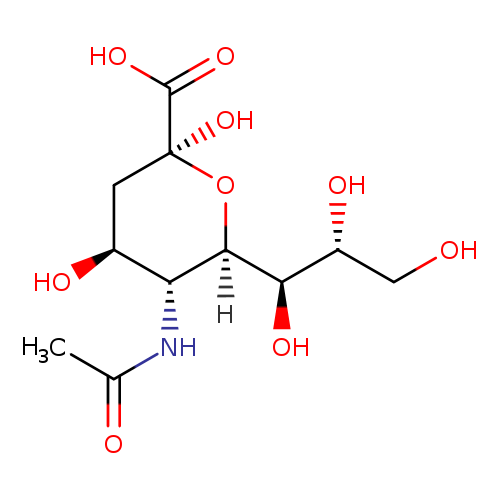
N-Acetylneuraminic acid, also known as N-acetylneuraminate or sialic acid, belongs to the class of organic compounds known as n-acylneuraminic acids. These are neuraminic acids carrying an N-acyl substituent. N-Acetylneuraminic acid exists as a solid, possibly soluble (in water), and an extremely weak basic (essentially neutral) compound (based on its pKa) molecule. N-Acetylneuraminic acid exists in all living organisms, ranging from bacteria to humans. N-Acetylneuraminic acid participates in a number of enzymatic reactions, within cattle. In particular, N-Acetylneuraminic acid can be biosynthesized from N-acetylmannosamine and phosphoenolpyruvic acid; which is catalyzed by the enzyme sialic acid synthase. In addition, N-Acetylneuraminic acid can be converted into N-acetylmannosamine and pyruvic acid; which is mediated by the enzyme N-acetylneuraminate lyase. In cattle, N-acetylneuraminic acid is involved in the metabolic pathway called the amino sugar metabolism pathway. N-Acetylneuraminic acid is a potentially toxic compound. N-Acetylneuraminic acid has been found to be associated with several diseases known as sialidosis, normosomatic type, irritable bowel syndrome, ulcerative colitis, and colorectal cancer; also n-acetylneuraminic acid has been linked to the inborn metabolic disorders including salla disease.
Glycosylation of bovine milk caseins is limited to k-casein, which can have up to nine glycans per molecule, such as galactose, N-acetylgalactosamine, N-acetylneuraminic acid, and sialic acid [89].
Written in the paper as “N-acetylneuraminic acid” and “milk”
The acidification of milk starts with the neutralization of aspartate (pKa = 4.25) and glutamate (pKa = 4.05) residues followed by the phosphate groups (pKa = 2.2, 5.8, and 12.4) and sialic acid present as part of O-glycosylation (pKa = 2.2) [105].
The oligosaccharide profiles for all three species are dominated by acidic structures, with 43 of cow, 46 of goat, and 61 of sheep oligosaccharide structures contain Neu5Ac or Neu5Gc.
SA rarely exist in free form in nature [29]; in milk, it is bound to lactose to form sialyllactose (SL) to more complex oligosaccharides or glycoproteins [30].
N-Acetyl neuraminic acid was determined to be the dominant form of sialic acid in the milk from both sources; no signals corresponding to the presence of N-glycolyl neuraminic acid were detected in the commercial bovine gangliosides or the extracts that we prepared from either bovine milk or human milk.
Written in the paper as “N-Acetyl neuraminic acid” and “milk”
Previous studies have reported that some animal milks contain acidic oligosaccharides with N-acetylneuraminic acid (Neu5Ac), resulting in an oligosaccharide profile similar to human milk.
Written in the paper as “N-acetylneuraminic acid” and “milk”
Fucosylation, sialylation, primarily with N-acetylneuraminic acid (Neu5Ac), and a high ratio of N,N′-diacetyllactosamine (LacdiNAc)/N-acetyllactosamine (LacNAc) motifs were characteristic features of the identified N-glycans.
Written in the paper as “N-acetylneuraminic acid” and “milk”
The building blocks of Holstein and Jersey milk oligosaccharides are glucose (Glc), galactose (Gal), N-acetylglucosamine (GlcNAc), N-acetylgalactosamine (GalNAc), N-acetylneuraminic acid (NeuAc) and N-glycolylneuraminic acid (NeuGc).
Written in the paper as “N-acetylneuraminic acid” and “milk”
Although NeuAc sialylation was observed in both milk samples, the NeuGc residue was only observed in bovine milk and marks a major difference between human and bovine milks.
Written in the paper as “N-acetylneuraminic acid” and “milk”
Two classes of OS have been identified in bovine milk; acidic OS containing sialic acid (in the form of N-acetyl neuraminic acid or N-acetyl glycolyl neuraminic acid) and neutral OS containing N-acetylhexosamine (11).
58 compositions (without considering isomers) were identified in bovine milk, 52 of total were fucosylated structures, 59 of the components included one or more sialic acid.
The dominant component of milk oligosaccharides is soluble free oligosaccharides that consist of D-glucose (Glc), D-galactose (Gal), N-acetylglucosamine (GlcNAc), L-fucose, and N-acetylneuraminic acid (NeuAc).
Written in the paper as “N-acetylneuraminic acid” and “milk”
Monosaccharide analyses of glyco-forms of aLA have revealed varying amounts of N-acetylglucosamine(GlcNAc), N-acetylgalactosamine (GalNAc), mannose (Man), galactose (Gal), fucose (Fuc), and N-acetylneuraminic acid (NeuAc), the quantities of Gal, Fuc, and NeuAc being relatively low [36].
Written in the paper as “N-acetylneuraminic acid” and “milk”
OS from human and bovine milk typically consist of a lactose core at the reducing end, which is elongated by the monosaccharides galactose (Gal), N-acetylglucosamine (GlcNAc), N-acetylgalactosamine (GalNAc, bovine only), fucose (Fuc), N-acetylneuraminic acid (NeuAc), and N-glycolylneuraminic acid (NeuGc, bovine only, found in trace abundance)16,27,29.
Written in the paper as “N-acetylneuraminic acid” and “milk”
Notably, sialic acid on some milk glycoproteins have been implicated in binding E. coli and Salmonella enteritidis [43,56], increasing growth of the bifidobacterial spp. such as B. breve, B. bifidum, B infantis [57], and preventing Helicobacter pylori colonization [58].
The OS in bovine milk are highly sialylated, with nearly 70 of the structures in colostrum and 50 of the structures in mature milk containing sialic acid (Tao et al., 2008; Tao, DePeters, German, Grimm, Lebrilla, 2009).
By use of 1H NMR spectroscopy, lactose and monosaccharides (fucose, galactose, glucose, N-acetyl-glucosamine (GlcNAc), N-acetyl-galactosamine (GalNAc), N-acetyl-neuraminic acid, (NeuAc)) were identified and quantified (Figure 3).
Written in the paper as “N-acetyl-neuraminic acid” and “milk”
The five k-CN glycosylation forms are referred to as the a, b, c, d and e types, constituting galactose (Gal), N-acetyl-galactosamine (GalNAc) and N-acetyl-neuraminic acid (sialic acid, NeuAc) [25,26,27], where a = GalNAc (Mw = 203.19 Da), b = Galb(1-3)GalNAc (Mw = 365.34 Da), c = NeuAca(2-3)Galb(1-3)GalNAc (Mw = 656.59 Da), d = Galb(1-3)[NeuAca(2-6)]GalNAc (Mw = 656.59 Da), and e = NeuAca(2-3)Galb(1-3)[NeuAca(2-6)]GalNAc (Mw = 947.85 Da).
Written in the paper as “N-acetyl-neuraminic acid” and “milk”
Interestingly, sialylation with NeuAc, NeuGc, and also with the combination of NeuAc and NeuGc within the same glycan, were all detected in the bovine milk samples, particularly in the first days following parturition.
Written in the paper as “N-acetylneuraminic acid” and “milk”
Fucosylation, sialylation, primarily with N-acetylneuraminic acid (Neu5Ac), and a high ratio of N,N′-diacetyllactosamine (LacdiNAc)/N-acetyllactosamine (LacNAc) motifs were characteristic features of the identified N-glycans.
Written in the paper as “N-acetylneuraminic acid” and “colostrum”
The OS in bovine milk are highly sialylated, with nearly 70 of the structures in colostrum and 50 of the structures in mature milk containing sialic acid (Tao et al., 2008; Tao, DePeters, German, Grimm, Lebrilla, 2009).
Written in the paper as “sialic acid” and “colostrum”
Preliminary screening of the raw files revealed strong oxonium ion evidence for the occurrence of sialylation with N-acetylneuraminic acid (NeuAc) and N-glycolylneuraminic acid (NeuGc), but not for the occurrence of acetylated sialic acid residues, or of deaminated neuraminic acid (Kdn) (Supplementary Fig. S15).
Written in the paper as “N-acetylneuraminic acid” and “colostrum”
Zhao et al. (12) demonstrated that sialic acid from the microbiota-gut-mammary axis aggravated mastitis caused by disturbances in the commensal bacteria of the intestine.
Written in the paper as “sialic acid” and “intestine”
This genus seems to have developed a mechanism avoiding the host immune system by the production of sialic acid which is one of the main compounds constituting the mucus covering the intestine (Severi et al., 2007; Quintana-Hayashi et al., 2018).
Written in the paper as “sialic acid” and “intestine”
Mucus is a bodily fluid consisting of a slippery secretion of the lining of the mucous membranes in the body. It is a viscous colloid containing antiseptic enzymes (such as lysozyme) and immunoglobulins. Mucus is produced by goblet cells in the mucous membranes that cover the surfaces of the membranes. It is made up of mucins and inorganic salts suspended in water.
We previously showed that carbohydrates released by the mucus layer covering the small intestine enterocytes (mannose, N-acetylglucosamine [GlcNAc], N-acetylneuraminic acid [Neu5Ac] and galactose) were used by EHEC to grow in bovine small intestine content [17].
Written in the paper as “N-acetylneuraminic acid” and “mucus layer”
This genus seems to have developed a mechanism avoiding the host immune system by the production of sialic acid which is one of the main compounds constituting the mucus covering the intestine (Severi et al., 2007; Quintana-Hayashi et al., 2018).
This distinction between infectious mastitis (caused by direct bacterial invasion of the mammary gland via the teat canal) and non-infectious or metabolic mastitis (driven by translocation of microbial products such as LPS, sialic acid, or extracellular vesicles from the gut or rumen into systemic circulation, which then activate mammary NLRP3 in the absence of intramammary pathogens) is a critical conceptual advance.
The detailed protein composition of MFGM-enriched ingredients is not systematically disclosed in technical data sheets; however, most the ingredients prepared from cream, beta serum, or buttermilk contain measurable amounts of gangliosides, MFGM proteins, cholesterol, sialic acid, IgG, and lactoferrin [41,42,43,44,45].
Written in the paper as “sialic acid” and “Beta serum”
PLS-DA of the serum metabolite profiles derived from both negative and positive ionisation modes m/z exhibited some discrimination between MAP challenged and control cattle, albeit with overlapping of 95 confidence intervals, PLS-DA models 24-months post MAP inoculation are shown in Fig. 1.
Written in the paper as “N-Acetylneuraminate” and “serum”
Monomers of the six main carbohydrates present in the mucus covering the bovine small intestine epithelium (galactose, GlcNAc, GalNAc, fucose, mannose and Neu5Ac) [25] have been previously detected in bovine small intestinal contents [17].
Written in the paper as “Neu5Ac” and “bovine small intestinal contents”
Instead, bovine tissues abundantly display N-glycolylneuraminic acid (Neu5Gc) in addition to N-acetylneuraminic acid (Neu5Ac) [45], thus the stereochemistry of the terminal glycosidic bond does not equate to entry efficacy, and analysis of complex glycoconjugates is needed to assess this distinction on the level of receptor binding.
Written in the paper as “N-acetylneuraminic acid” and “bovine tissues”
The metabolic pathways of sialylated oligosaccharides initiate with the biosynthesis of sialic acid in the cytosol by conversion of UDP-N-acetylglucosamine (UDP-GlcNAc) to N-acetylmannosamine (ManNAc) followed by phosphorylation to ManNAc-6-phosphate by the bifuncational enzyme UDP-N-acetylglucosamine-2-epimerase/N-acetylmannosamine kinase (GNE).
Written in the paper as “sialic acid” and “cytosol”
This distinction between infectious mastitis (caused by direct bacterial invasion of the mammary gland via the teat canal) and non-infectious or metabolic mastitis (driven by translocation of microbial products such as LPS, sialic acid, or extracellular vesicles from the gut or rumen into systemic circulation, which then activate mammary NLRP3 in the absence of intramammary pathogens) is a critical conceptual advance.
This observation shows that the bovine mammary gland is able to produce a higher than normal amount of sialic acid when presented with an increased amount of substrate, apparently without exceeding its capacity to synthesise this sugar group.
Written in the paper as “sialic acid” and “mammary gland”
A substance that is secreted by a mammary gland. The substance may differ depending on phase, with colostrum produced during pregancy/early lactation, and milk produced afterwards.
C) Glycan features, i.e. neutral (black), fucosylated (red), and sialylated with N-acetylneuraminic acid (Neu5Ac; purple) and N-glycolylneuraminic acid (Neu5Gc; light blue), of the N-glycans as a function of the glycoprotein they belong to and during lactation.
Written in the paper as “N-acetylneuraminic acid” and “mammary secretions”
PAS IV contained mannose, galactose, and sialic acid as principal sugars (approximately 5.3% total carbohydrate [wt/wt]) and existed in milk in at least four isoelectric variants.
Written in the paper as “sialic acid” and “milk-fat-globule membrane”
The presence of oligosaccharides containing GlcNAc, fucose and sialic acid make mother liquor potentially an ideal dairy source for commercial production of oligosaccharides-enriched ingredients for the food and beverage industries.
Written in the paper as “sialic acid” and “mother liquor”
As mentioned above, EHEC activated the transcription of genes required for the assimilation of galactose, GlcNAc, Neu5Ac, fucose and GalNac in rectum contents.
Written in the paper as “Neu5Ac” and “rectum contents”
Is component of
Red Blood Cell
A red blood cell. In mammals, mature erythrocytes are biconcave disks containing hemoglobin whose function is to transport oxygen.
Hemolytic anaemia in trypanosomosis is usually due to mechanical injury to the erythrocytes and to the subsequent lysis caused by the lashing action of Trypanosoma flagella and attachment of the trypanosomes onto red blood cell surfaces via sialic acid receptors [70].
Written in the paper as “sialic acid” and “red blood cell”
The pseudostratified ciliated epithelium that lines much of the conducting portion of the airway, including part of the nasal cavity and larynx, the trachea, and bronchi.
This distinction between infectious mastitis (caused by direct bacterial invasion of the mammary gland via the teat canal) and non-infectious or metabolic mastitis (driven by translocation of microbial products such as LPS, sialic acid, or extracellular vesicles from the gut or rumen into systemic circulation, which then activate mammary NLRP3 in the absence of intramammary pathogens) is a critical conceptual advance.
Written in the paper as “sialic acid” and “systemic circulation”
The susceptibility and rapid viral replication of HPAIV in the mammary gland are consistent with the evidence of highly abundant a2,3-linked sialic acid receptors in the bovine udder18.
Zhao et al. (12) demonstrated that sialic acid from the microbiota-gut-mammary axis aggravated mastitis caused by disturbances in the commensal bacteria of the intestine.
Written in the paper as “sialic acid” and “mastitis”
Specifically, Neu5Ac predominantly promotes the growth of Enterobacteriaceae and enhances the expression of virulence factors such as ler and tir, exacerbating mastitis [15].
Experimental validation demonstrated that sialic acid treatment specifically induced mastitis only when gut dysbiosis was present, associated with enhanced growth of harmful bacteria including Escherichia coli, Enterobacteriaceae, and Akkermansiaceae, while interventions targeting pathogenic Enterobacteriaceae or supplementing with beneficial Lactobacillus reuteri effectively alleviated mastitis symptoms.
Written in the paper as “sialic acid” and “mastitis”
Zhao, C. et al. [50] identified sialic acid as a crucial metabolic fuel that exacerbates gut dysbiosis and drives mastitis development, with cows experiencing subacute ruminal acidosis-associated mastitis exhibiting elevated sialic acid levels and distinct microbial communities characterized by increased pathogenic Moraxellaceae and reduced beneficial Prevotellaceae.
Written in the paper as “sialic acid” and “mastitis”
Furthermore, LPS-induced mucosal inflammation stimulates sialic acid release which pathogens, including Escherichia coli, exploit to expand the population of opportunistic pathogens which further exacerbates microbial dysbiosis and subsequent mastitis [22, 23].
Written in the paper as “sialic acid” and “mastitis”
Sialic acid metabolism operates through an opposing mechanism: elevated rumen sialic acid in SARA-affected cows promotes expansion of Enterobacteriaceae and Akkermansiaceae, potentiates serum LPS levels, and activates mammary TLR4-NF-kB/NLRP3 signaling.
Written in the paper as “Sialic acid” and “subacute ruminal acidosis”
In contrast, SARA-induced increases in sialic acid promote Enterobacteriaceae overgrowth, resulting in gut dysbiosis, increased LPS levels, and mammary inflammation through TLR4-NF-kB/NLRP3 signaling.
Written in the paper as “sialic acid” and “subacute ruminal acidosis”
This distinction between infectious mastitis (caused by direct bacterial invasion of the mammary gland via the teat canal) and non-infectious or metabolic mastitis (driven by translocation of microbial products such as LPS, sialic acid, or extracellular vesicles from the gut or rumen into systemic circulation, which then activate mammary NLRP3 in the absence of intramammary pathogens) is a critical conceptual advance.
Written in the paper as “sialic acid” and “non-infectious mastitis”
In SARA-associated mastitis, sialic acids, including N-glycolylneuraminic acid (Neu5Gc) and N-acetylneuraminic acid (Neu5Ac), were identified as the most differentially enriched metabolites in mastitis cows.
Written in the paper as “N-acetylneuraminic acid” and “SARA-associated mastitis”
Zhao, C. et al. [50] identified sialic acid as a crucial metabolic fuel that exacerbates gut dysbiosis and drives mastitis development, with cows experiencing subacute ruminal acidosis-associated mastitis exhibiting elevated sialic acid levels and distinct microbial communities characterized by increased pathogenic Moraxellaceae and reduced beneficial Prevotellaceae.
Written in the paper as “sialic acid” and “subacute ruminal acidosis-associated mastitis”
The process whose specific outcome is the progression of the brain over time, from its formation to the mature structure. Brain development begins with patterning events in the neural tube and ends with the mature structure that is the center of thought and emotion. The brain is responsible for the coordination and control of bodily activities and the interpretation of information from the senses (sight, hearing, smell, etc.).
Dietary supplementation with various forms of sialic acid (free or bound to milk OS or protein-linked glycans) has improved learning and increased brain sialic acid content in animal studies (49-51), suggesting that these carbohydrates make an important contribution to brain development.
Written in the paper as “sialic acid” and “brain development”
Fucosylation, sialylation, primarily with N-acetylneuraminic acid (Neu5Ac), and a high ratio of N,N′-diacetyllactosamine (LacdiNAc)/N-acetyllactosamine (LacNAc) motifs were characteristic features of the identified N-glycans.
Written in the paper as “N-acetylneuraminic acid” and “sialylation”
Preliminary screening of the raw files revealed strong oxonium ion evidence for the occurrence of sialylation with N-acetylneuraminic acid (NeuAc) and N-glycolylneuraminic acid (NeuGc), but not for the occurrence of acetylated sialic acid residues, or of deaminated neuraminic acid (Kdn) (Supplementary Fig. S15).
Written in the paper as “N-acetylneuraminic acid” and “sialylation”
HA subtypes 1 through 16 mediate viral entry by binding to sialic acid (SA) receptors on host cells, specifically those presenting a2,6-linked sialic acid (a2,6 SA) or a2,3-linked (a2,3 SA) sialic acid.
Written in the paper as “sialic acid” and “viral entry”
The operation of the mind by which an organism becomes aware of objects of thought or perception; it includes the mental activities associated with thinking, learning, and memory.
Furthermore, sialic acid, a component of milk OS, is essential for brain development and cognitive function of neonates4.
Written in the paper as “sialic acid” and “cognitive function”
Produced by
N-acetylneuraminate biosynthetic process GO:0046380
The chemical reactions and pathways resulting in the formation of N-acetylneuraminate, the anion of 5-(acetylamino)-3,5-dideoxy-D-glycero-D-galacto-non-3-ulosonic acid.
For example, Mann et al. (2018) showed that one microbial gene encoding for N-acetylneuraminate synthase and involved in sialic acid synthesis was highly expressed in the rumen microbiome in all cattle tested.
Written in the paper as “sialic acid” and “sialic acid synthesis”
The neuABCD locus is involved in sialic acid synthesis and their presence in S. uberis 56A indicates it may produce a capsule to assist with immune system evasion66, 67.
Written in the paper as “sialic acid” and “sialic acid synthesis”
A protein glycosylation process in which a carbohydrate or carbohydrate derivative unit is added to a protein via the N4 atom of an asparagine residue.
In hmLF, complex/hybrid types of N-glycans consisting of 3-6 Hex, 3-7 HexNAc, 0-3 Fuc and 0-2 NeuAc are mainly present (>99 ) on three N-glycosylation sites at Asn156, Asn497 and Asn642 [47].
Written in the paper as “n-acetylneuraminic acid” and “N-glycosylation”
While N-glycosylation of bovine a-lactalbumin at Asn74 has never been reported, partial occupancy of Asn45 has been shown in previous studies, primarily with complex diantennary N-glycans containing LacNAc and/or N,N -diacetyllactosamine (LacdiNAc) motifs, fucosylation and Neu5Ac sialylation, with on average 10 of total a-lactalbumin occurring as a glycoprotein (Barman 1970; Hindle and Wheelock 1970; Hopper and McKenzie 1973; Chandrika 1999; Slangen and Visser 1999; Valk-Weeber et al. 2020).
Written in the paper as “Neu5Ac” and “N-glycosylation”
E.g., in our previous study we identified N-acetylneuraminic acid (Neu5Ac) sialylation as a hallmark of bovine colostrum IgG, concluding that the high occurrence of Neu5Ac likely played a role in the transepithelial transport, resistance to digestive proteases and longer half-life of bovine IgG in providing passive immunity to the calf (Gazi et al. 2023).
Written in the paper as “N-acetylneuraminic acid” and “N-acetylneuraminic acid sialylation”
We found bovine milk IgG glycosylation to be highly diverse and complex, seemingly much more so than human IgG glycosylation, and we identified biological features of the bovine milk IgG N-glycosylation, such as NeuAc sialylation, that are a hallmark of bovine colostrum, greatly diminishing in mature bovine milk.
Written in the paper as “N-acetylneuraminic acid” and “N-acetylneuraminic acid sialylation”
The acidification of milk starts with the neutralization of aspartate (pKa = 4.25) and glutamate (pKa = 4.05) residues followed by the phosphate groups (pKa = 2.2, 5.8, and 12.4) and sialic acid present as part of O-glycosylation (pKa = 2.2) [105].
Written in the paper as “sialic acid” and “acidification of milk”
The amino acid metabolites including N-acetylneuraminic acid, N-g-acetyl-N-2-formyl-5-methylkynurenine, and glycyl-phenylalanine (Gly-Phe) were significantly upregulated (Fig. S3e, c, and f) indicating the elevated amino acid metabolism, while metabolites associated with lipid oxidation including thromboxane B2 (TXB2), arachidonic acid (AA), and eicosapentaenoic acid (EPA) were significantly downregulated (Figs. S4d, c, and v).
Written in the paper as “N-acetylneuraminic acid” and “amino acid metabolism”
The change in morphology and behavior of a mature or immature B cell resulting from exposure to a mitogen, cytokine, chemokine, cellular ligand, or an antigen for which it is specific.
This enzyme mediates binding of sialic acid to surface proteins and therefore the reason for its association with this neutral OS is currently unclear.
Written in the paper as “sialic acid” and “binding of sialic acid to surface proteins”
Likewise, another study suggested that supplementation of isolated dietary SA led to increased cortical ganglioside SA content in developing rats, suggesting that the beneficial effects of sialic acid on cognitive function may be due to its alteration of brain composition to support early brain development [97].
Written in the paper as “sialic acid” and “early brain development”
Moreover, M. tuberculosis, alongside other bacteria, exhibit sialic acid decorated proteins which act as receptors and are capable of masking recognition sites and provide protection from humoral and cellular immune system responses (Bhagavat Chandra, 2013).
Written in the paper as “sialic acid” and “humoral and cellular immune system responses”
The process whose specific outcome is the progression of an organismal system whose objective is to provide calibrated responses by an organism to a potential internal or invasive threat, over time, from its formation to the mature structure. A system is a regularly interacting or interdependent group of organs or tissues that work together to carry out a given biological process.
This expanded tropism is supported by the presence of SAs in these tissues and the capacity of MBCS in HPAI viruses to facilitate HA activation outside the respiratory tract (54, 55).
Written in the paper as “sialic acid” and “influenza virus infection”
Neu5Ac can enter bifidobacterial cells via specific transporters, drive their metabolic pathways, thereby promoting the growth of beneficial bacteria and inhibiting the intestinal adhesion of pathogens such as Escherichia coli and Clostridium difficile.
Written in the paper as “Neu5Ac” and “intestinal adhesion of pathogens”
A process that modulates synaptic plasticity such that synapses are changed resulting in the increase in the rate, or frequency of synaptic transmission at the synapse.
Long-term potentiation (LTP) for signal transmission between neurons, Y maze test and IntelliCageR Protocol test (an automated testing system for spontaneous and learning behavior of rodents) performance at one year were significantly improved with both Neu5Ac and 6 -SL supplementations during lactation [55].
Written in the paper as “Neu5Ac” and “Long-term potentiation”
Meanwhile, N-Acetylneuraminic Acid plays a crucial role in assisting the synapses between neurons and skeletal muscles and also contributes to maintaining neuromuscular connections, ultimately promoting muscle contraction.
Written in the paper as “N-Acetylneuraminic Acid” and “maintaining neuromuscular connections”
Sialic acid metabolism operates through an opposing mechanism: elevated rumen sialic acid in SARA-affected cows promotes expansion of Enterobacteriaceae and Akkermansiaceae, potentiates serum LPS levels, and activates mammary TLR4-NF-kB/NLRP3 signaling.
Written in the paper as “Sialic acid” and “mammary TLR4-NF-kB/NLRP3 signaling”
The activities involved in the mental information processing system that receives (registers), modifies, stores, and retrieves informational stimuli. The main stages involved in the formation and retrieval of memory are encoding (processing of received information by acquisition), storage (building a permanent record of received information as a result of consolidation) and retrieval (calling back the stored information and use it in a suitable way to execute a given task).
The function of the brain in learning and memory appears to be related to the high recognition abilities of the glycoproteins in the brain [29], and there is evidence indicating that the SA content of brain glycoproteins is involved in memory formation [93,94].
Written in the paper as “SA” and “memory formation”
A process in which force is generated within muscle tissue, resulting in a change in muscle geometry. Force generation involves a chemo-mechanical energy conversion step that is carried out by the actin/myosin complex activity, which generates force through ATP hydrolysis.
Meanwhile, N-Acetylneuraminic Acid plays a crucial role in assisting the synapses between neurons and skeletal muscles and also contributes to maintaining neuromuscular connections, ultimately promoting muscle contraction.
Written in the paper as “N-Acetylneuraminic Acid” and “muscle contraction”
Up-regulation of the genes encoding proteins involved in the transport or metabolism of N-acetylneuraminic acid (Neu5Ac, nanAT), N-acetylglucosamine (GlcNAc, nagABE) and galactose (galKMPT and mglABC) was unique to EDL933 incubated in posterior DCs (Table 3).
Written in the paper as “N-acetylneuraminic acid” and “transport or metabolism of N-acetylneuraminic acid”
Neu5Ac is a key substance for neural development, capable of enhancing learning ability and potentially alleviating neurological issues related to hydrocephalus (Wang, 2012).
Written in the paper as “Neu5Ac” and “neural development”
Sialic acid is important for synapse formation and neural transmission (Schnaar et al., 2014), which may account for the differences in cognitive performance between breastfed and non-breastfed populations.
Written in the paper as “sialic acid” and “neural transmission”
A glycoprotein biosynthetic process starting with the covalent linkage of carbohydrate or carbohydrate derivative unit via a glycosidic bond to the oxygen atom of a serine, threonine, hydroxylysine, hydroxyproline or tyrosine side chain in a protein, which can be further elongated with the sequential addition of sugar units resulting in the formation of a protein O-linked glycan.
The acidification of milk starts with the neutralization of aspartate (pKa = 4.25) and glutamate (pKa = 4.05) residues followed by the phosphate groups (pKa = 2.2, 5.8, and 12.4) and sialic acid present as part of O-glycosylation (pKa = 2.2) [105].
Written in the paper as “sialic acid” and “O-glycosylation”
Involved in
protein O-linked glycosylation via N-acetylgalactosamine GO:0016266
A glycoprotein biosynthetic process starting with the covalent linkage of an N-acetyl-galactosamine via an alpha-glycosidic bond to the oxygen atom of a serine or threonine side chain in a protein, which can be further elongated with the sequential addition of sugar units resulting in the formation of a protein O-linked glycan.
Bovine k-casein residues, including Thr154 (41 ), Thr163 (29 ), Thr152 (14 ), Thr142 (7 ), and Thr157 (0.1 ) [68], can be O-glycosylated with the following molecules: disaccharides (N-acetyl galactosamine and galactose; GalNAcGal); linear and branched trisaccharides (N-acetyl galactosamine, galactose, and N-acetyl neuraminic acid; GalNAcGalNeuAc); and branched tetrasaccharides (N-acetyl galactosamine, galactose, and two N-acetyl neuraminic acids; GalNAc1Gal1NeuAc2) [69].
Written in the paper as “N-acetyl neuraminic acid” and “O-glycosylated”
Of particular interest in the ST198 genomes is an eight ORF region (region 3 in Table 7) responsible for sialic acid transport, a key feature of mammalian pathogens that allows them to scavenge sialic acid and utilize it as a carbon source in the host intestine (AEX15_07505, AEX15_07550) [64][65][66].
Written in the paper as “sialic acid” and “sialic acid transport”
Sialic acid is important for synapse formation and neural transmission (Schnaar et al., 2014), which may account for the differences in cognitive performance between breastfed and non-breastfed populations.
Written in the paper as “sialic acid” and “synapse formation”
Furthermore, sialic acid potentiated serum LPS levels caused by antibiotic treatment, leading to increased activation of the TLR4-NF-kB/NLRP3 pathways in the mammary gland and colon.
Written in the paper as “sialic acid” and “TLR4-NF-kB/NLRP3 pathways”
In contrast, SARA-induced increases in sialic acid promote Enterobacteriaceae overgrowth, resulting in gut dysbiosis, increased LPS levels, and mammary inflammation through TLR4-NF-kB/NLRP3 signaling.
Written in the paper as “sialic acid” and “TLR4-NF-kB/NLRP3 signaling”
The neurological system process in which a signal is transmitted through the nervous system by a combination of action potential propagation and synaptic transmission.
Long-term potentiation (LTP) for signal transmission between neurons, Y maze test and IntelliCageR Protocol test (an automated testing system for spontaneous and learning behavior of rodents) performance at one year were significantly improved with both Neu5Ac and 6 -SL supplementations during lactation [55].
Written in the paper as “Neu5Ac” and “signal transmission between neurons”
The susceptibility and rapid viral replication of HPAIV in the mammary gland are consistent with the evidence of highly abundant a2,3-linked sialic acid receptors in the bovine udder18.
Written in the paper as “sialic acid” and “viral replication”
A multi-organism process in which a virus is a participant. The other participant is the host. Includes infection of a host cell, replication of the viral genome, and assembly of progeny virus particles. In some cases the viral genetic material may integrate into the host genome and only subsequently, under particular circumstances, 'complete' its life cycle.
Viral hemagglutinin (HA) binds to sialic acid (Sia) receptors on the cell surface to initiate the infection process, and substitutions in HA can alter the receptor binding affinity, which affects viral replication, transmission, and host range.
Written in the paper as “sialic acid” and “infection process”
Microbial mechanisms associated with low feed efficiency animals involved potential pathogens within Proteobacteria and Spirochaetales, releasing less energetic substrates (e.g., acetate) or producing sialic acid to avoid the host immune system.
Written in the paper as “sialic acid” and “feed efficiency”
Glycosylation of milk serum proteins could be related to glycosylation of membrane proteins, as the protein concentration in milk was observed to be strongly correlated with N-acetyl-galactosamine (Nac-Gal), N-acetyl-glucosamine (Nac-Glu), N-acetyl-neuraminic acid, and choline.
Written in the paper as “N-acetyl-neuraminic acid” and “protein concentration in milk”
It is well known that sialic acid-containing glycans provide significant health benefits, where a major focus has been on their role in brain development of neonates [29].
Written in the paper as “sialic acid” and “brain development of neonates”
Of particular interest in the ST198 genomes is an eight ORF region (region 3 in Table 7) responsible for sialic acid transport, a key feature of mammalian pathogens that allows them to scavenge sialic acid and utilize it as a carbon source in the host intestine (AEX15_07505, AEX15_07550) [64][65][66].
Written in the paper as “sialic acid” and “carbon source”
It has been shown in developing piglets that sialic acid supplementation of a milk formula acts as a conditional nutrient during periods of rapid brain growth [11].
Written in the paper as “sialic acid” and “conditional nutrient”
These isolated glycoproteins on MFGMs have been shown to inhibit hemagglutination of Helicobacter pylori in vitro, and human MFGM-associated lactadherin inhibited rotavirus binding and infection in vitro, likely by acting as a decoy for binding, as removal of sialic acid resulted in the loss of inhibitory activity (28-30).
Written in the paper as “sialic acid” and “decoy for binding”
Zhao, C. et al. [50] identified sialic acid as a crucial metabolic fuel that exacerbates gut dysbiosis and drives mastitis development, with cows experiencing subacute ruminal acidosis-associated mastitis exhibiting elevated sialic acid levels and distinct microbial communities characterized by increased pathogenic Moraxellaceae and reduced beneficial Prevotellaceae.
Written in the paper as “sialic acid” and “metabolic fuel”
Yamamoto, Toshihiro; Teshima, Tadashi; Inami, Kaoru; Shiba, Tetsuo. Synthesis of sialic acid through aldol condensation of glucose with oxalacetic acid. Tetrahedron Letters (1992), 33(3), 325-8.
Material Safety Data Sheet (MSDS)
Not Available
General References
Paul McJarrow, Janneke van Amelsfort-Schoonbeek (2004). International Dairy Journal: Volume 14, Issue 7, July 2004, Pages 571-579. International Dairy Journal.
Kurt J. Boudonck, Matthew W. Mitchell, Jacob Wulff and John A. Ryals (2009). Kurt J. Boudonck, Matthew W. Mitchell, Jacob Wulff and John A. Ryals. Characterization of the biochemical variability of bovine milk using metabolomics. Metabolomics (2009) 5:375?386. Metabolomics.
P. A. Morrissey (1973). The N-acetyl neuraminic-acid content of the milk of various species Journal of Dairy Research (1973), 40: 421-425 Cambridge University Press doi: 10.1017/S0022029900014795 (About doi) . Journal of Dairy Research.
Catalyzes the cleavage of N-acetylneuraminic acid (sialic acid) to form pyruvate and N-acetylmannosamine via a Schiff base intermediate. It prevents sialic acids from being recycled and returning to the cell surface. Involved in the N-glycolylneuraminic acid (Neu5Gc) degradation pathway (By similarity).
Involved in N-acylneuraminate cytidylyltransferase acti
Specific function:
Catalyzes the activation of N-acetylneuraminic acid (NeuNAc) to cytidine 5'-monophosphate N-acetylneuraminic acid (CMP-NeuNAc), a substrate required for the addition of sialic acid. Has some activity toward NeuNAc, N-glycolylneuraminic acid (Neu5Gc) or 2-keto-3-deoxy-D-glycero-D-galacto-nononic acid (KDN) (By similarity).
Catalyzes the removal of sialic acid (N-acetylneuraminic acid) moieties from glycoproteins and glycolipids. To be active, it is strictly dependent on its presence in the multienzyme complex. Appears to have a preference for alpha 2-3 and alpha 2-6 sialyl linkage (By similarity).
Involved in G-protein coupled receptor protein signalin
Specific function:
Receptor for a number of inflammatory CC-chemokines including MIP-1-alpha, MIP-1-beta and RANTES and subsequently transduces a signal by increasing the intracellular calcium ion level. May play a role in the control of granulocytic lineage proliferation or differentiation (By similarity).