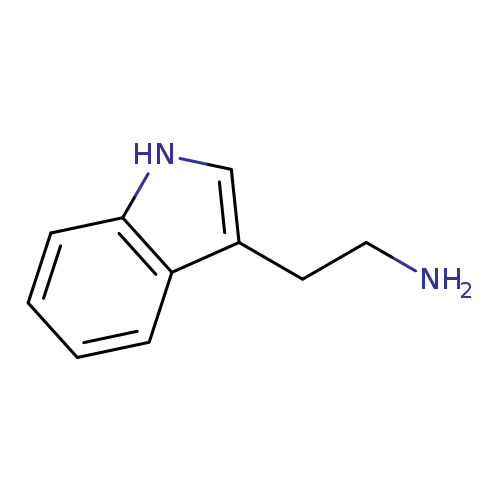
Tryptaminee belongs to the class of organic compounds known as tryptaminees and derivatives. Tryptaminees and derivatives are compounds containing the tryptaminee backbone, which is structurally characterized by an indole ring substituted at the 3-position by an ethanamine. Tryptaminee exists as a solid, possibly soluble (in water), and a very strong basic compound (based on its pKa) molecule. Tryptaminee exists in all living organisms, ranging from bacteria to humans. Tryptaminee participates in a number of enzymatic reactions, within cattle. In particular, Tryptaminee can be biosynthesized from L-tryptophan; which is mediated by the enzyme aromatic-L-amino-acid decarboxylase. In addition, Tryptaminee can be converted into indoleacetaldehyde through the action of the enzyme kynurenine 3-monooxygenase. In cattle, tryptaminee is involved in the metabolic pathway called the tryptophan metabolism pathway.
belongs to the class of organic compounds known as tryptamines and derivatives. Tryptamines and derivatives are compounds containing the tryptamine backbone, which is structurally characterized by an indole ring substituted at the 3-position by an ethanamine.
Pus is a bodily fluid consisting of a whitish-yellow or yellow substance produced during inflammatory responses of the body that can be found in regions of pyogenic bacterial infections. Pus is produced from the dead and living cells which travel into the intercellular spaces around the affected cells.
Among the 15 amino acid metabolites in the top 50 biochemicals, four were tryptophan metabolites, indoleacrylate, indolepropionate, tryptamine, and anthranilate.
Written in the paper as “tryptamine” and “Abscess purulent materials”
It has been recognized that the yield of harmful and toxic substances, such as lactate (particularly the D-isomer), ethanol, histamine, tyramine, tryptamine, and bacterial endotoxin (or lipopolysaccharide, LPS), in the rumen increases as a result of grain-based SARA [1,2].
Written in the paper as “tryptamine” and “subacute ruminal acidosis”
After grain-based SARA, many harmful or toxic substances increase in the rumen, including LPS, histamine, tyramine, tryptamine, ethanol and D-lactate [5].
Written in the paper as “tryptamine” and “subacute ruminal acidosis”
Mao et al. [70] reported that bacterial degradation products (xanthine, uracil, hypoxanthine, etc.), inflammatory compounds (LPS, ethanolamine, glutaric acid, lactate, biogenic amines including putrescine, histamine, tryptamine, tyramine, etc.) and amino acids (alanine, glycine, isoleucine, etc.) increased in the rumen of dairy cows during a grain-based SARA challenge.
Written in the paper as “tryptamine” and “Subacute ruminal acidosis”
Our results include all metabolites associated with acidosis that were identified in previous studies, except for ethanolamine, phenylacetylglycine, tyramine, and putrescine.
Written in the paper as “tryptamine” and “acidosis”
As reported by Wang et al [23], the concentrations of metabolites based on biogenic amines (tyramine, putrescine, histamine, methylamine, and tryptamine) in the rumen fluid were observed to be higher in bovines suffering from acidosis.
Written in the paper as “tryptamine” and “acidosis”
A localized, circumscribed collection of purulent material (pus) within the liver parenchyma, typically resulting from a bacterial, parasitic, or fungal infection. Unlike hepatitis, which is often diffuse, an abscess is a focal lesion.
Among the 15 amino acid metabolites in the top 50 biochemicals, four were tryptophan metabolites, indoleacrylate, indolepropionate, tryptamine, and anthranilate.
Written in the paper as “tryptamine” and “liver abscesses”
Likewise, Tata et al., (2021) found increased creatine, creatinine and tryptamine levels within MAP infected and infectious cattle, compared to controls.
Written in the paper as “tryptamine” and “Mycobacterium avium subspecies paratuberculosis”
Metabolites such as tryptamine (TAM), 5-hydroxytryptophan (5-HTP), 5-Methoxytrytamine (5-MT), and N-acetylserotonin derived from TRP metabolism (Fig. 5C) were also present in fermented milk.
Written in the paper as “tryptamine” and “tryptophan metabolism”
Cereal grains from the plant classified under the species Zea mays L. subsp. mays, commonly known as Maize grain or Corn grain. The part consumed/analysed is not specified. When relevant, information on the part consumed/analysed has to be reported with additional facet descriptors. In case of data collections related to legislations, the default part consumed/analysed is the one defined in the applicable legislation.[https://en.wikipedia.org/wiki/Maize] and [https://www.google.co.uk/search?tbm=isch&q=Maize+grain]
The study by Mao et al. also showed that some toxic, inflammatory and abnormal metabolites increased with increasing dietary corn grain, such as LPS, tryptamine, tyramine, histamine and phenylacetate [46].
Written in the paper as “tryptamine” and “corn grain”
It has been recognized that the yield of harmful and toxic substances, such as lactate (particularly the D-isomer), ethanol, histamine, tyramine, tryptamine, and bacterial endotoxin (or lipopolysaccharide, LPS), in the rumen increases as a result of grain-based SARA [1,2].
Mao et al. [70] reported that bacterial degradation products (xanthine, uracil, hypoxanthine, etc.), inflammatory compounds (LPS, ethanolamine, glutaric acid, lactate, biogenic amines including putrescine, histamine, tryptamine, tyramine, etc.) and amino acids (alanine, glycine, isoleucine, etc.) increased in the rumen of dairy cows during a grain-based SARA challenge.
Written in the paper as “tryptamine” and “grain-based diets”
Abramovitch, R. A.; Shapiro, D. Tryptamines, carbolines, and related compounds. II. A convenient synthesis of tryptamines and b-carbolines. Journal of the Chemical Society (1956), 4589-92.