| Record Information |
|---|
| Version | 1.0 |
|---|
| Creation Date | 2016-09-30 22:29:08 UTC |
|---|
| Update Date | 2020-04-22 15:03:06 UTC |
|---|
| BMDB ID | BMDB0000352 |
|---|
| Secondary Accession Numbers | |
|---|
| Metabolite Identification |
|---|
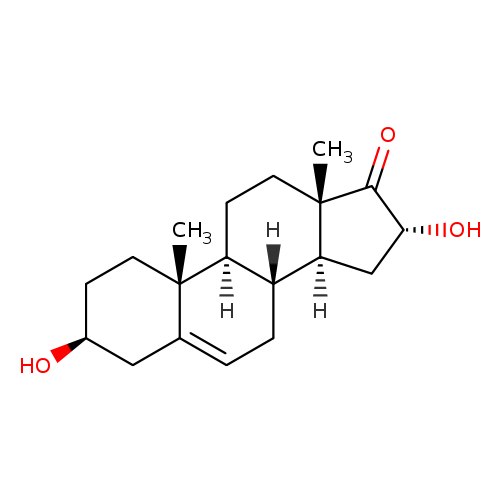
| Common Name | 16a-Hydroxydehydroisoandrosterone |
|---|
| Description | 16a-Hydroxydehydroisoandrosterone, also known as 3b,16a-dihydroxy-androst-5-en-17-one or 5-androstene-3beta,16alpha-diol-17-one, belongs to the class of organic compounds known as androgens and derivatives. These are 3-hydroxylated C19 steroid hormones. They are known to favor the development of masculine characteristics. They also show profound effects on scalp and body hair in humans. Thus, 16a-hydroxydehydroisoandrosterone is considered to be a steroid lipid molecule. 16a-Hydroxydehydroisoandrosterone is a very hydrophobic molecule, practically insoluble (in water), and relatively neutral. |
|---|
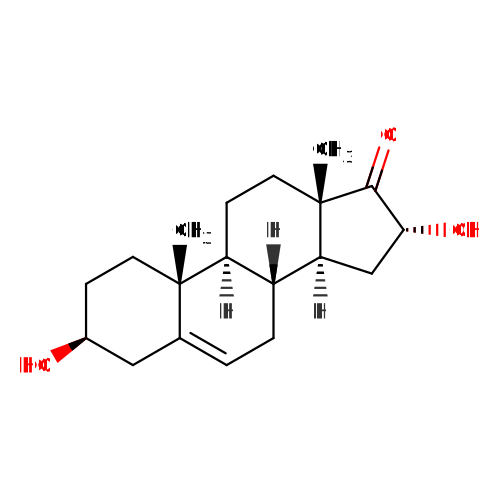
| Structure | |
|---|
| Synonyms | | Value | Source |
|---|
| 16alpha-Hydroxydehydroisoandrosterone | ChEBI | | 3beta,16alpha-Dihydroxy-androst-5-en-17-one | ChEBI | | 5-Androstene-3beta,16alpha-diol-17-one | ChEBI | | 16Α-hydroxydehydroisoandrosterone | Generator | | 3b,16a-Dihydroxy-androst-5-en-17-one | Generator | | 3Β,16α-dihydroxy-androst-5-en-17-one | Generator | | 5-Androstene-3b,16a-diol-17-one | Generator | | 5-Androstene-3β,16α-diol-17-one | Generator | | 16 alpha-Hydroxy-dehydroepiandrosterone | HMDB | | 16-Hydroxydehydroandrosterone | HMDB | | 16-Hydroxydehydroepiandrosterone | HMDB | | 16a-Hydroxy-dhea | HMDB | | 16a-Hydroxydehydroandrosterone | HMDB | | 16a-Hydroxydehydroepiandrosterone | HMDB | | 3b,16a-Dihydroxyandrost-5-en-17-one | HMDB | | Androst-5-ene-3b-16a-diol-17-one | HMDB | | 16alpha-Hydroxy-dehydroepiandrosterone | HMDB | | 3beta,16alpha-Dihydroxyandrost-5-en-17-one | HMDB | | 16 alpha-Hydroxydehydroisoandrosterone | HMDB | | 3,16-Dihydroxyandrost-5-en-17-one | HMDB | | 3 beta,16 beta-Dihydroxyandrost-5-en-17-one | HMDB | | 16 beta-Hydroxydehydroepiandrosterone | HMDB | | 3 beta,16 alpha-Dihydroxyandrost-5-en-17-one | HMDB | | 16-Hydroxydehydroepiandrosterone, (16beta)-isomer | HMDB | | 16-Hydroxydehydroepiandrosterone, (3alpha,16alpha)-isomer | HMDB | | 16Α-hydroxydehydroepiandrosterone | HMDB | | 16a-Hydroxydehydroisoandrosterone | Generator |
|
|---|
| Chemical Formula | C19H28O3 |
|---|
| Average Molecular Weight | 304.4238 |
|---|
| Monoisotopic Molecular Weight | 304.203844762 |
|---|
| IUPAC Name | (1S,2R,5S,10R,11S,13R,15S)-5,13-dihydroxy-2,15-dimethyltetracyclo[8.7.0.0²,⁷.0¹¹,¹⁵]heptadec-7-en-14-one |
|---|
| Traditional Name | 16a-Hydroxy-DHEA |
|---|
| CAS Registry Number | 1232-73-1 |
|---|
| SMILES | [H][C@@]12C[C@@H](O)C(=O)[C@@]1(C)CC[C@@]1([H])[C@@]2([H])CC=C2C[C@@H](O)CC[C@]12C |
|---|
| InChI Identifier | InChI=1S/C19H28O3/c1-18-7-5-12(20)9-11(18)3-4-13-14(18)6-8-19(2)15(13)10-16(21)17(19)22/h3,12-16,20-21H,4-10H2,1-2H3/t12-,13+,14-,15-,16+,18-,19-/m0/s1 |
|---|
| InChI Key | QQIVKFZWLZJXJT-DNKQKWOHSA-N |
|---|
| Chemical Taxonomy |
|---|
| Description | belongs to the class of organic compounds known as androgens and derivatives. These are 3-hydroxylated C19 steroid hormones. They are known to favor the development of masculine characteristics. They also show profound effects on scalp and body hair in humans. |
|---|
| Kingdom | Organic compounds |
|---|
| Super Class | Lipids and lipid-like molecules |
|---|
| Class | Steroids and steroid derivatives |
|---|
| Sub Class | Androstane steroids |
|---|
| Direct Parent | Androgens and derivatives |
|---|
| Alternative Parents | |
|---|
| Substituents | - Androgen-skeleton
- 3-hydroxy-delta-5-steroid
- 3-hydroxysteroid
- 3-beta-hydroxysteroid
- 16-hydroxysteroid
- 16-alpha-hydroxysteroid
- 3-beta-hydroxy-delta-5-steroid
- Oxosteroid
- 17-oxosteroid
- Hydroxysteroid
- Delta-5-steroid
- Cyclic alcohol
- Secondary alcohol
- Ketone
- Organic oxygen compound
- Organooxygen compound
- Carbonyl group
- Hydrocarbon derivative
- Alcohol
- Organic oxide
- Aliphatic homopolycyclic compound
|
|---|
| Molecular Framework | Aliphatic homopolycyclic compounds |
|---|
| External Descriptors | |
|---|
| Ontology |
|---|
| Status | Expected but not Quantified |
|---|
| Origin | |
|---|
| Biofunction | Not Available |
|---|
| Application | Not Available |
|---|
| Cellular locations | - Cell membrane
- Cytoplasm
- Endoplasmic reticulum
- Membrane
|
|---|
| Physical Properties |
|---|
| State | Solid |
|---|
| Experimental Properties | | Property | Value | Reference |
|---|
| Melting Point | Not Available | Not Available | | Boiling Point | Not Available | Not Available | | Water Solubility | Not Available | Not Available | | LogP | Not Available | Not Available |
|
|---|
| Predicted Properties | |
|---|
| Spectra |
|---|
| Spectra | |
|---|