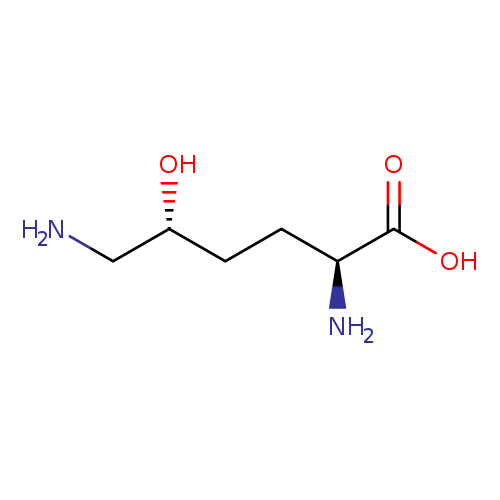
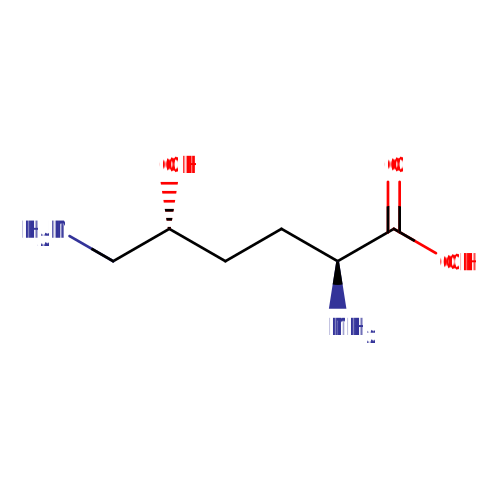
5-Hydroxylysine, also known as lysine, 5 hydroxy, belongs to the class of organic compounds known as l-alpha-amino acids. These are alpha amino acids which have the L-configuration of the alpha-carbon atom. 5-Hydroxylysine is possibly soluble (in water) and a very strong basic compound (based on its pKa). 5-Hydroxylysine exists in all eukaryotes, ranging from yeast to humans. In cattle, 5-hydroxylysine is involved in the metabolic pathway called the lysine degradation pathway.
belongs to the class of organic compounds known as l-alpha-amino acids. These are alpha amino acids which have the L-configuration of the alpha-carbon atom.
The chemical reactions and pathways resulting in the formation of collagen, any of a group of fibrous proteins of very high tensile strength that form the main component of connective tissue in animals. Collagen is highly enriched in glycine (some regions are 33% glycine) and proline, occurring predominantly as 3-hydroxyproline (about 20%).
DL-plus allo-d-Hydroxylysine, identified as an enzyme and glutamine synthetase inhibitor, experiences reduced levels under HS conditions (33 oC, 60 humidity) in pigs and plays a role in bovine collagen synthesis, potentially affected by HS37,38.
Written in the paper as “DL-plus allo-d-Hydroxylysine” and “bovine collagen synthesis”
DL-plus allo-d-Hydroxylysine, identified as an enzyme and glutamine synthetase inhibitor, experiences reduced levels under HS conditions (33 oC, 60 humidity) in pigs and plays a role in bovine collagen synthesis, potentially affected by HS37,38.
Written in the paper as “DL-plus allo-d-Hydroxylysine” and “enzyme and glutamine synthetase inhibitor”
Allevi, P.; Anastasia, M. Synthesis of all four possible stereoisomers of 5-hydroxylysine. Tetrahedron: Asymmetry (2000), 11(15), 3151-3160.
Material Safety Data Sheet (MSDS)
Not Available
General References
Mung D, Li L: Development of Chemical Isotope Labeling LC-MS for Milk Metabolomics: Comprehensive and Quantitative Profiling of the Amine/Phenol Submetabolome. Anal Chem. 2017 Apr 18;89(8):4435-4443. doi: 10.1021/acs.analchem.6b03737. Epub 2017 Mar 28. [PubMed:28306241 ]
Mung D, Li L: Applying quantitative metabolomics based on chemical isotope labeling LC-MS for detecting potential milk adulterant in human milk. Anal Chim Acta. 2018 Feb 25;1001:78-85. doi: 10.1016/j.aca.2017.11.019. Epub 2017 Nov 14. [PubMed:29291809 ]