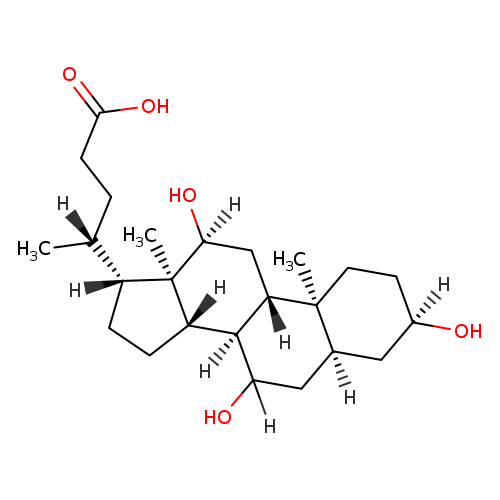
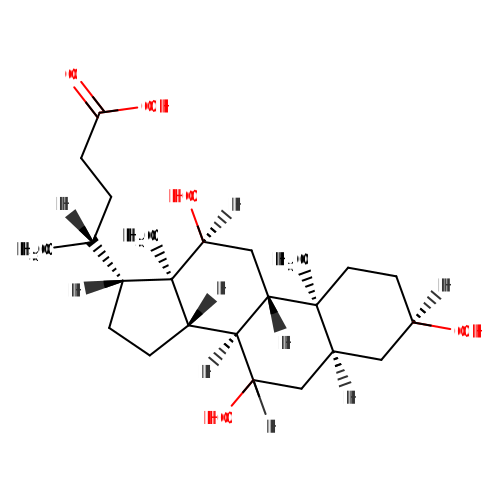
Cholic acid, also known as cholate, belongs to the class of organic compounds known as trihydroxy bile acids, alcohols and derivatives. These are prenol lipids structurally characterized by a bile acid or alcohol which bears three hydroxyl groups. Cholic acid is an extremely weak basic (essentially neutral) compound (based on its pKa).
belongs to the class of organic compounds known as trihydroxy bile acids, alcohols and derivatives. These are prenol lipids structurally characterized by a bile acid or alcohol which bears three hydroxyl groups.
For instance, in dairy cows, cholic acid (CA) and chenodeoxycholic acid (CDCA) constitute the predominant primary bile acids, accounting for up to 80 of the primary or primary-conjugated bile acids present in the liver [17].
The primary bile acids such as cholic and chenodeoxycholic acids are produced in the liver from the catabolism of cholesterol in cattle (Sheriha et al. 1968).
Fluctuations in the levels of a number of bile acids (3-oxocholic acid, cholic acid and NDGCA) were observed in plasma of animals at various stages in the study.
Written in the paper as “cholic acid” and “plasma”
Metabolites consisted primarily of amino acids, byproducts of glucose metabolism and the tricarboxylic acid (TCA) cycle, and varied other small molecules such as myo-Inositol, Cholate, and the nucleosides Uridine and Deoxyuridine.
Written in the paper as “Cholate” and “follicular fluid”
Recent studies have found that cholic acid is present in the follicular fluid of both humans and bovines and is closely related to oocyte maturation and embryo development (38, 39).
Written in the paper as “cholic acid” and “follicular fluid”
Moreover, 20 of the differential metabolites identified in the stool were derived from common metabolic processes between the host and gut microbiota (Fig. 2B), including linoleic acid, 4-pyridoxic acid, cytidine, citrulline, and cholic acid (Table S5).
Once the primary bile acids, including cholic acid (CA) and chenodeoxycholic acid (CDCA) enter the gastrointestinal tract, over 50 natural secondary bile acids are produced [9].
Written in the paper as “cholic acid” and “gastrointestinal tract”
Metabolomic profiling revealed dose-dependent changes in cholic acid, which is reported to suppress methane formation39,40, and 2,6-diaminopimelic acid, whose accumulation suggests enhanced microbial growth and hydrogen utilization41,42.
A total of 118 metabolites was identified in the urine sample; just 17 metabolites (Acetoin, cholate, gallate, hippurate, histidine, kynurenate, etc.) of them were identified in urine sample (Fig 1 and S2 Table).
Zhao, C. et al. [61] showed that SARA cows exhibited significantly reduced levels of both primary bile acid cholic acid (CA) and secondary bile acid deoxycholic acid (DCA) in their milk compared to healthy cows, directly associated with increased susceptibility to Staphylococcus aureus-induced mastitis.
Written in the paper as “cholic acid” and “subacute ruminal acidosis”
Meanwhile, some metabolites were decreased in the pathogenesis of SARA, such as cholic acid, L-ascorbic acid, adenine, 2-hydroxyvaleric acid, 3-hydroxysebacic acid, 5 -methythioadenosine, deoxyribose, hippuric acid, phosphorycholine, L-isoleucine, 3-hydroxytetradecanedipnic acid and propenoycarnitine and so on [99].
Written in the paper as “cholic acid” and “Subacute ruminal acidosis”
Cows with mastitis exhibit reduced levels of cholic acid (CA) and deoxycholic acid (DCA) in milk, and DCA, but not CA, alleviates S. aureus-induced mastitis in mice [24].
Written in the paper as “cholic acid” and “mastitis”
By contrast, in addition to the 8 metabolites noted above (Table 1), 4 additional metabolites including cholic acid (CA), glycocholic acid (GCA), taurocholic acid (TCA), and taurolithocholic acid (TLCA) were found to be lower in plasma samples from repeat breeder cows than that from healthy cows.
Written in the paper as “cholic acid” and “repeat breeder”
The synthesis of bile acids, including cholic acid and chenodeoxycholic acid, is a complex process involving at least 17 enzymes and metabolite transport proteins.
Written in the paper as “cholic acid” and “bile acid synthesis”
This operon includes C7 hydroxyl dehydroxylation of cholic acid (CA) and chenodeoxycholic acid (CDCA), resulting in the production of deoxycholic acid (DCA) and lithocholic acid (LCA), respectively [2].
Written in the paper as “cholic acid” and “C7 hydroxyl dehydroxylation of cholic acid”
The chemical reactions and pathways involving bile acids, a group of steroid carboxylic acids occurring in bile, where they are present as the sodium salts of their amides with glycine or taurine.
A critical mechanistic pathway linking gut health to mastitis susceptibility involves bile acid metabolism, as demonstrated in subacute ruminal acidosis (SARA) models.
Written in the paper as “cholic acid” and “bile acid metabolism”
The process whose specific outcome is the progression of an embryo from its formation until the end of its embryonic life stage. The end of the embryonic stage is organism-specific. For example, for mammals, the process would begin with zygote formation and end with birth. For insects, the process would begin at zygote formation and end with larval hatching. For plant zygotic embryos, this would be from zygote formation to the end of seed dormancy. For plant vegetative embryos, this would be from the initial determination of the cell or group of cells to form an embryo until the point when the embryo becomes independent of the parent plant.
Recent studies have found that cholic acid is present in the follicular fluid of both humans and bovines and is closely related to oocyte maturation and embryo development (38, 39).
Written in the paper as “cholic acid” and “embryo development”
The chemical reactions and pathways resulting in the formation of methane, a colorless, odorless, flammable gas with the formula CH4. It is the simplest of the alkanes.
Metabolomic profiling revealed dose-dependent changes in cholic acid, which is reported to suppress methane formation39,40, and 2,6-diaminopimelic acid, whose accumulation suggests enhanced microbial growth and hydrogen utilization41,42.
Written in the paper as “cholic acid” and “methane formation”
A developmental process, independent of morphogenetic (shape) change, that is required for an oocyte to attain its fully functional state. Oocyte maturation commences after reinitiation of meiosis commonly starting with germinal vesicle breakdown, and continues up to the second meiotic arrest prior to fertilization.
Recent studies have found that cholic acid is present in the follicular fluid of both humans and bovines and is closely related to oocyte maturation and embryo development (38, 39).
Written in the paper as “cholic acid” and “oocyte maturation”
Key differential metabolites in the secondary bile acid biosynthesis signaling pathway include allocholic acid, alpha-phocaecholic acid, taurochenodeoxycholate, cholic acid, and bitocholate (Figure 2D).
Written in the paper as “cholic acid” and “secondary bile acid biosynthesis”
Metabolomic profiling revealed dose-dependent changes in cholic acid, which is reported to suppress methane formation39,40, and 2,6-diaminopimelic acid, whose accumulation suggests enhanced microbial growth and hydrogen utilization41,42.
Written in the paper as “cholic acid” and “methane emissions”
Concentrations of gamma-linolenic acid (C18:3 n-6) and bile acids (cholic acid, glycocholic acid, and taurocholic acid) were lower in HE cows, whereas concentrations of oleic acid were greater in HE cows compared with LE cows (Figure 2).
Written in the paper as “cholic acid” and “residual feed intake”
Conversely, a high-grain diet fed to cows increases cholic acid levels in the intestine, which correlates with an enhanced inflammatory response [130].
Written in the paper as “cholic acid” and “high-grain diet”
Calimente, Daniel. Synthesis and characterization of new naphthalimide and cholic acid-containing complexing agents. (1998), 104 pp.
Material Safety Data Sheet (MSDS)
Not Available
General References
Kurt J. Boudonck, Matthew W. Mitchell, Jacob Wulff and John A. Ryals (2009). Kurt J. Boudonck, Matthew W. Mitchell, Jacob Wulff and John A. Ryals. Characterization of the biochemical variability of bovine milk using metabolomics. Metabolomics (2009) 5:375?386. Metabolomics.
Kurt J. Boudonck, Matthew W. Mitchell, Jacob Wulff and John A. Ryals (2009). Kurt J. Boudonck, Matthew W. Mitchell, Jacob Wulff, John A. Ryals. Characterization of the biochemical variability of bovine milk using metabolomics. Metabolomics (2009) 5:375-386 doi: 10.1007/s11306-009-0160-8. Metabolomics.