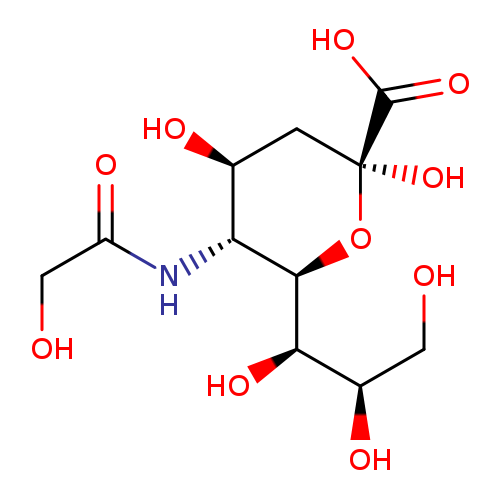
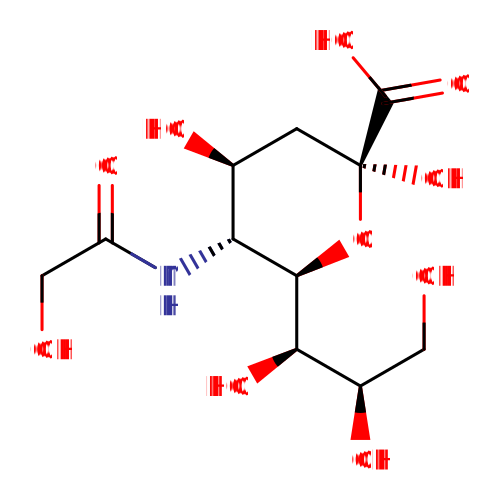
N-Glycolylneuraminic acid, also known as N-glycolyl-b-neuraminate or gcneu, belongs to the class of organic compounds known as neuraminic acids. These are carbohydrate derivatives containing a neuraminic acid moiety. N-Glycolylneuraminic acid is an extremely weak basic (essentially neutral) compound (based on its pKa).
The oligosaccharide profiles for all three species are dominated by acidic structures, with 43 of cow, 46 of goat, and 61 of sheep oligosaccharide structures contain Neu5Ac or Neu5Gc.
The building blocks of Holstein and Jersey milk oligosaccharides are glucose (Glc), galactose (Gal), N-acetylglucosamine (GlcNAc), N-acetylgalactosamine (GalNAc), N-acetylneuraminic acid (NeuAc) and N-glycolylneuraminic acid (NeuGc).
Written in the paper as “N-glycolylneuraminic acid” and “milk”
Although NeuAc sialylation was observed in both milk samples, the NeuGc residue was only observed in bovine milk and marks a major difference between human and bovine milks.
Two classes of OS have been identified in bovine milk; acidic OS containing sialic acid (in the form of N-acetyl neuraminic acid or N-acetyl glycolyl neuraminic acid) and neutral OS containing N-acetylhexosamine (11).
Written in the paper as “N-acetyl glycolyl neuraminic acid” and “milk”
OS from human and bovine milk typically consist of a lactose core at the reducing end, which is elongated by the monosaccharides galactose (Gal), N-acetylglucosamine (GlcNAc), N-acetylgalactosamine (GalNAc, bovine only), fucose (Fuc), N-acetylneuraminic acid (NeuAc), and N-glycolylneuraminic acid (NeuGc, bovine only, found in trace abundance)16,27,29.
Written in the paper as “N-glycolylneuraminic acid” and “milk”
Similarly, Robinson et al. (2019) identified no OS containing NeuGc in mid-lactation milk, while Sundekilde et al. (2012) identified three OS structures containing NeuGc in Holstein milk with an average lactation stage of 165 days.
Interestingly, sialylation with NeuAc, NeuGc, and also with the combination of NeuAc and NeuGc within the same glycan, were all detected in the bovine milk samples, particularly in the first days following parturition.
Preliminary screening of the raw files revealed strong oxonium ion evidence for the occurrence of sialylation with N-acetylneuraminic acid (NeuAc) and N-glycolylneuraminic acid (NeuGc), but not for the occurrence of acetylated sialic acid residues, or of deaminated neuraminic acid (Kdn) (Supplementary Fig. S15).
Written in the paper as “N-glycolylneuraminic acid” and “colostrum”
Instead, bovine tissues abundantly display N-glycolylneuraminic acid (Neu5Gc) in addition to N-acetylneuraminic acid (Neu5Ac) [45], thus the stereochemistry of the terminal glycosidic bond does not equate to entry efficacy, and analysis of complex glycoconjugates is needed to assess this distinction on the level of receptor binding.
Written in the paper as “N-glycolylneuraminic acid” and “bovine tissues”
A substance that is secreted by a mammary gland. The substance may differ depending on phase, with colostrum produced during pregancy/early lactation, and milk produced afterwards.
C) Glycan features, i.e. neutral (black), fucosylated (red), and sialylated with N-acetylneuraminic acid (Neu5Ac; purple) and N-glycolylneuraminic acid (Neu5Gc; light blue), of the N-glycans as a function of the glycoprotein they belong to and during lactation.
Written in the paper as “N-glycolylneuraminic acid” and “mammary secretions”
In SARA-associated mastitis, sialic acids, including N-glycolylneuraminic acid (Neu5Gc) and N-acetylneuraminic acid (Neu5Ac), were identified as the most differentially enriched metabolites in mastitis cows.
Written in the paper as “N-glycolylneuraminic acid” and “SARA-associated mastitis”
Absence of NeuGc in mid-lactation milk may be a benefit, since NeuGc has been associated with negative health outcomes, by possibly promoting inflammation and cancer progression (Samraj et al., 2015).
Written in the paper as “NeuGc” and “cancer progression”
The immediate defensive reaction (by vertebrate tissue) to infection or injury caused by chemical or physical agents. The process is characterized by local vasodilation, extravasation of plasma into intercellular spaces and accumulation of white blood cells and macrophages.
Absence of NeuGc in mid-lactation milk may be a benefit, since NeuGc has been associated with negative health outcomes, by possibly promoting inflammation and cancer progression (Samraj et al., 2015).
Written in the paper as “NeuGc” and “inflammation”
Involved in
metabolic binding to newly synthesized polysaccharides
Exogenous N-glycolylneuraminic acid can participate in metabolic binding to newly synthesized polysaccharides and appear on human tissue cells (Nguyen, Tangvoranuntakul, Varki, 2005).
Written in the paper as “N-glycolylneuraminic acid” and “metabolic binding to newly synthesized polysaccharides”
Previous studies have shown differences at the bovine N-glycome level, where N-glycolylneuraminic acid (Neu5Gc) sialylation was gradually lost during the transition from colostrum to mature milk (Takimori et al. 2011).
Written in the paper as “N-glycolylneuraminic acid” and “N-glycolylneuraminic acid sialylation”
Notably, Neu5Gc sialylation was contributed exclusively by signature proteins of colostrum, particularly immunoglobulin heavy chain constants, the JCHAIN and PIGR, while the mature milk proteins, including a-lactalbumin, only carried Neu5Ac sialylation (Fig. 1).
Written in the paper as “Neu5Gc” and “Neu5Gc sialylation”
A very interesting feature of the bovine milk IgG glycosylation found was the fact that NeuAc and NeuGc sialylation occurred simultaneously in the samples, at times even both on the same glycoprotein (Fig. 4, Supplementary Fig. S12).
Written in the paper as “NeuGc” and “NeuGc sialylation”
A protein glycosylation process in which a carbohydrate or carbohydrate derivative unit is added to a protein via the N4 atom of an asparagine residue.
Preliminary screening of the raw files revealed strong oxonium ion evidence for the occurrence of sialylation with N-acetylneuraminic acid (NeuAc) and N-glycolylneuraminic acid (NeuGc), but not for the occurrence of acetylated sialic acid residues, or of deaminated neuraminic acid (Kdn) (Supplementary Fig. S15).
Written in the paper as “N-glycolylneuraminic acid” and “sialylation”