Loading
Record Information
Version1.0
Creation Date2016-09-30 22:40:39 UTC
Update Date2026-11-27 18:55:27 UTC
BMDB IDBMDB0001066
Secondary Accession Numbers
  • BMDB01066
Metabolite Identification
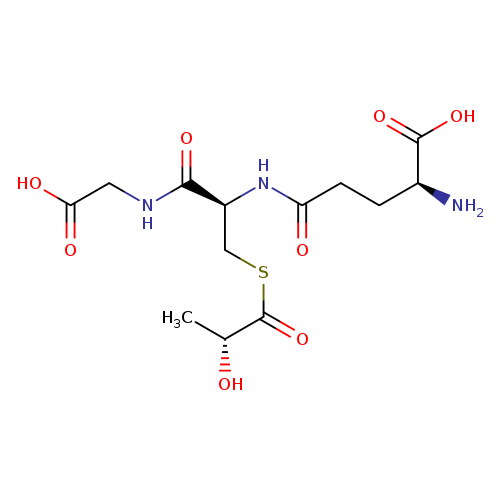
Common NameS-Lactoylglutathione
Description
S-Lactoylglutathione belongs to the class of organic compounds known as oligopeptides. These are organic compounds containing a sequence of between three and ten alpha-amino acids joined by peptide bonds. S-Lactoylglutathione is a very strong basic compound (based on its pKa). S-Lactoylglutathione exists in all living species, ranging from bacteria to humans.
Structure
Thumb
Synonyms
ValueSource
S-D-LactoylglutathioneChEBI
(R)-S-LactoylglutathioneHMDB
D-LactoylglutathioneHMDB
delta-LactoylglutathioneHMDB
N-(N-L-gamma-Glutamyl-S-(2-hydroxy-1-oxopropyl)-L-cysteinyl)-glycineHMDB
S-D-Lactoyl-glutathioneHMDB
S-delta-Lactoyl-glutathioneHMDB
S-delta-LactoylglutathioneHMDB
S-Lactate glutathioneHMDB
S-LactateglutathioneHMDB
S-Lactoyl-glutathioneHMDB
S-LactylglutathioneHMDB
S-[(2R)-2-Hydroxypropanoyl]-gamma-L-glutamyl-L-cysteinylglycineHMDB
Chemical FormulaC13H21N3O8S
Average Molecular Weight379.386
Monoisotopic Molecular Weight379.104935353
IUPAC Name(2S)-2-amino-4-{[(1R)-1-[(carboxymethyl)carbamoyl]-2-{[(2R)-2-hydroxypropanoyl]sulfanyl}ethyl]carbamoyl}butanoic acid
Traditional NameS-lactoylglutathione
CAS Registry Number25138-66-3
SMILES
C[C@@H](O)C(=O)SC[C@H](NC(=O)CC[C@H](N)C(O)=O)C(=O)NCC(O)=O
InChI Identifier
InChI=1S/C13H21N3O8S/c1-6(17)13(24)25-5-8(11(21)15-4-10(19)20)16-9(18)3-2-7(14)12(22)23/h6-8,17H,2-5,14H2,1H3,(H,15,21)(H,16,18)(H,19,20)(H,22,23)/t6-,7+,8+/m1/s1
InChI KeyVDYDCVUWILIYQF-CSMHCCOUSA-N
Chemical Taxonomy
Description belongs to the class of organic compounds known as oligopeptides. These are organic compounds containing a sequence of between three and ten alpha-amino acids joined by peptide bonds.
KingdomOrganic compounds
Super ClassOrganic acids and derivatives
ClassCarboxylic acids and derivatives
Sub ClassAmino acids, peptides, and analogues
Direct ParentOligopeptides
Alternative Parents
Substituents
  • Alpha-oligopeptide
  • Gamma-glutamyl alpha peptide
  • S-(2-hydroxyacyl)glutathione
  • S-acylglutathione
  • Glutamine or derivatives
  • N-acyl-alpha amino acid or derivatives
  • N-acyl-alpha-amino acid
  • Alpha-amino acid amide
  • Cysteine or derivatives
  • Alpha-amino acid
  • N-substituted-alpha-amino acid
  • Alpha-amino acid or derivatives
  • L-alpha-amino acid
  • N-acyl-amine
  • Fatty acyl
  • Fatty amide
  • Dicarboxylic acid or derivatives
  • Fatty acid
  • Secondary carboxylic acid amide
  • Secondary alcohol
  • Amino acid or derivatives
  • Thiocarboxylic acid ester
  • Amino acid
  • Carboxamide group
  • Carbothioic s-ester
  • Sulfenyl compound
  • Carboxylic acid
  • Thiocarboxylic acid or derivatives
  • Organosulfur compound
  • Primary amine
  • Organic nitrogen compound
  • Alcohol
  • Carbonyl group
  • Hydrocarbon derivative
  • Amine
  • Organic oxide
  • Organopnictogen compound
  • Organic oxygen compound
  • Primary aliphatic amine
  • Organooxygen compound
  • Organonitrogen compound
  • Aliphatic acyclic compound
Molecular FrameworkAliphatic acyclic compounds
External Descriptors
Ontology
StatusExpected but not Quantified
Origin
  • Endogenous
Biofunction
Not Available
Application
Not Available
Cellular locations
  • Mitochondria
Physical Properties
StateSolid
Experimental Properties
PropertyValueReference
Melting PointNot AvailableNot Available
Boiling PointNot AvailableNot Available
Water SolubilityNot AvailableNot Available
LogPNot AvailableNot Available
Predicted Properties
PropertyValueSource
logP-2.9ALOGPS
logP-5.4ChemAxon
logS-1.7ALOGPS
pKa (Strongest Acidic)1.74ChemAxon
pKa (Strongest Basic)9.31ChemAxon
Physiological Charge-1ChemAxon
Hydrogen Acceptor Count9ChemAxon
Hydrogen Donor Count6ChemAxon
Polar Surface Area196.12 ŲChemAxon
Rotatable Bond Count12ChemAxon
Refractivity84.78 m³·mol⁻¹ChemAxon
Polarizability36.01 ųChemAxon
Number of Rings0ChemAxon
BioavailabilityYesChemAxon
Rule of FiveYesChemAxon
Ghose FilterYesChemAxon
Veber's RuleYesChemAxon
MDDR-like RuleYesChemAxon
Spectra
Spectra
Biological Properties
Cellular Locations
  • Mitochondria
Biospecimen Locations
Not Available
Body Locations
Muscle: Skeletal Muscle Tissue
Muscle
Skeletal Muscle Tissue
Location Evidence
RelationTermDefinitionSources
Detected inSkeletal Muscle Tissue
UBERON:0001134
Muscle tissue that consists primarily of skeletal muscle fibers.
1 paper
Biological Processes
RelationTermDefinitionSources
Involved inProduced bycellular detoxification of methylglyoxal
GO:0140041
Any process carried out at the cellular level that reduces or removes the toxicity of methylglyoxal. These may include chemical modification or transport of methylglyoxal away from sensitive areas and to compartments or complexes whose purpose is sequestration of the toxic substance.
2 papers
Consumed byadenosine triphosphate synthesisNo definition available
1 paper
Activatesmilk protein synthesisNo definition available
1 paper
Production Traits
RelationTermDefinitionSources
Positively associated withmilk protein amount
VT:1000165
The proportion, quantity, or volume in milk of macromolecules consisting of long sequences of amino acids in peptide linkage.
1 paper
Biological Roles
RelationTermDefinitionSources
HasenergyNo definition available
1 paper
Haspyruvate metabolic raw materialNo definition available
1 paper
Pathways
Concentrations

No normal concentrations recorded

No abnormal concentrations recorded

HMDB IDHMDB0001066
DrugBank IDNot Available
Phenol Explorer Compound IDNot Available
FooDB IDFDB022405
KNApSAcK IDC00019550
Chemspider ID389032
KEGG Compound IDC03451
BioCyc IDS-LACTOYL-GLUTATHIONE
BiGG ID41876
Wikipedia LinkNot Available
METLIN ID5979
PubChem Compound440018
PDB IDNot Available
ChEBI ID15694
References
Synthesis ReferenceLiu, Yan; Hama, Hideki; Fujita, Yasuya; Kondo, Akihiko; Inoue, Yoshiharu; Kimura, Akira; Fukuda H. Production of S-lactoylglutathione by high activity whole cell biocatalysts prepared by permeabilization of recombinant Saccharomyces cerevisiae with alcohols. Biotechnol Bioeng. 1999 Jul 5;64(1):54-60.

Material Safety Data Sheet (MSDS)Not Available
General References
Not Available

Enzymes

General function:
Not Available
Specific function:
Catalyzes the conversion of hemimercaptal, formed from methylglyoxal and glutathione, to S-lactoylglutathione.
Gene Name:
GLO1
Uniprot ID:
A4FUZ1
Molecular weight:
20766.0
Reactions
S-Lactoylglutathione → Glutathione + Pyruvaldehydedetails