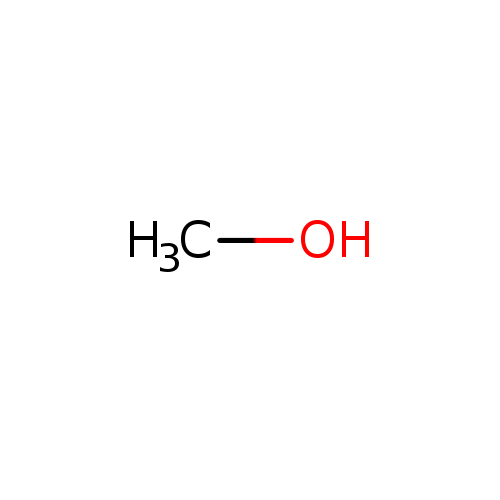
Methanol, also known as columbian spirit or methyl alcohol, belongs to the class of organic compounds known as primary alcohols. Primary alcohols are compounds comprising the primary alcohol functional group, with the general structure RCOH (R=alkyl, aryl). Methanol exists as a solid, possibly soluble (in water), and an extremely weak basic (essentially neutral) compound (based on its pKa) molecule. Methanol exists in all living organisms, ranging from bacteria to humans. Methanol is a potentially toxic compound.
belongs to the class of organic compounds known as primary alcohols. Primary alcohols are compounds comprising the primary alcohol functional group, with the general structure RCOH (R=alkyl, aryl).
Approximately 85 of the CH4 emitted by ruminant animals originates from rumen fermentation, primarily through the conversion by the methanogenic bacteria of CO2, H2, methanol, formic acid, and other compounds into CH4 [3].
Methanol is produced in the rumen through the hydrolysis of pectin, a carbohydrate absent in milk (Miller and Wolin, 1985; Pol and Demeyer, 1988; Fricke et al., 2006).
However, it is known that the concentration of methanogenic substrates (mainly hydrogen and methyl compounds such as methanol and methylamines) and the interactions between methanogens and microbes producing and consuming hydrogen in the rumen (165, 166) are important factors contributing to methane emissions.
Methanosarcina barkeri and Methanosarcina mazeii produce CH4 by using acetate, methylamine, and methanol, as well as H2 and CO2, which are present in the rumen [38].
Twenty-four hour mean concentrations of other plasma metabolites such as creatine, betaine, acetic acid, formic acid, dimethyl sulfone, 1-methylhistidine, 3-hydroxybutyric acid, methanol, pyruvic acid, scyllitol, ethanol, and creatinine are presented in Fig. 3a and b.
Table 5Pearson correlation coefficients between the relative concentration of 34 identified plasma metabolites and Bovine Respiratory Disease defined through six reference diagnosis methods.
These metabolites included anserine, imidazole, and acetate in ruminal fluid; methanol in serum; O-phosphocholine, isocitrate, lactose, lactulose, N-acetylglucosamine, ribose, and 3-hydroxyisovalerate in milk; and histamine, 1-methylhistidine, 5-hydroxyindole-3-acetate, N-nitrosodimethylamine, succinylacetone, 3-methylhistidine, 4-pyridoxate, N-acetylserotonin, and pyridoxine in urine.
A 6-lipid biomarker panel (i.e., C5-M-DC, C18:2, C3-OH, C16, C14:1-OH, and C16:2) at 8 weeks, and a 4-metabolite/lipid biomarker panel (i.e., C3-OH, methanol, C16, and PC ae C30:2) at 4 weeks prepartum were built as predictive urine biomarkers for ketosis based on VIP scores.
The chemical reactions and pathways resulting in the formation of methane, a colorless, odorless, flammable gas with the formula CH4. It is the simplest of the alkanes.
Methanosphaera use only methanol and H2 as substrates, while Methanobrevibacter uses the hydrogenotrophic pathway in which CO2, formate and H2 are metabolized to form CH4.
Written in the paper as “methanol” and “CH4 formation”
The dominant hydrogenotrophs in the rumen are methanogenic archaea, including those that use H2 as an energy source and electron donor to reduce CO2, formate, or methanol to CH4, and are ubiquitous in the gastrointestinal tracts of diverse ruminants.
Written in the paper as “methanol” and “methanogenesis”
The enzymes involved in methanogenesis pathways from methanol, acetate, methylamine and CO2, acetate, and propionate biosynthetic pathways were identified based on literature search and the corresponding KOs for these reactions were retrieved from the KEGG database [115].
Written in the paper as “methanol” and “methanogenesis pathways”
Ideally, for the elimination of one mol of CH4 production through methanogenesis from H2 + CO2, formate, or H2 + methanol, 4, 4, or 1 mol of H2 equivalent would be left behind, respectively; this calculation assumes that in the absence of its use, each mole of formate is oxidized to an equimolar amount of H2.
Written in the paper as “methanol” and “methanogenesis”
Although Ca. Methanomethylophilus alvus would be able to reduce methanol and or other methylated compounds for methanogenesis (Borrel et al., 2012), the diet composition did not promote its colonization in the rumen of MC calves (Table 1).
Written in the paper as “methanol” and “methanogenesis”
This family is obligate H2-dependent methylotrophs, utilizing methyl groups from methanol and methylamines (mono-, di-, and tri-methylamine) and methyl thiols for methanogenesis (Lambie et al., 2015).
Written in the paper as “methanol” and “methanogenesis”
Pectin degradation produces methanol, an important substrate for methane production by methylotrophs, and leads to microbial growth (often to greater extent than fermentation of starch)71, contributing to microbial protein synthesis, essential for animal growth and productivity72,73.
Written in the paper as “methanol” and “methane production”
The Methanomassiliicoccaceae family are obligate H2-dependent methylotrophs, utilising methyl groups from methanol and methylamines (mono-, di-, and tri-methylamine) and methyl thiols for the production of methyl coenzyme37 and provide additional NH4+ to rumen bacteria.
Written in the paper as “methanol” and “methane production”
The other minor contributor to methane production are the methylotrophic methanogens that oxidizes methyl groups from methanol or methylamines and it is estimated that 22 of archaea in the rumen use this pathway [98].
Written in the paper as “methanol” and “methane production”
Methanosphaera, recognized for its role in methanogenesis through methanol reduction, contributes to methane production in ruminants, primarily in the solid fraction of the rumen [71,72].
Written in the paper as “methanol” and “methanol reduction”
B The methanol-utilizing methanogenesis pathway (M00536), highlighting enzyme expression patterns converting methanol to methane via methyl-coenzyme M (Methyl-CoM).
Written in the paper as “methanol” and “methanol-utilizing methanogenesis pathway”
Functional profiling of methanogenesis pathways across these two taxa confirmed that Methanobrevibacter sp. RuMAGs encoded the genes to perform hydrogenotrophic methanogenesis while Methanomethylophilus sp. RuMAGs encoded the genes necessary for methylotrophic methanogenesis, which involves methanol and methylated amine reduction (Fig. 1B).
Written in the paper as “methanol” and “methylotrophic methanogenesis”
Furthermore, the reduction of methanol via methylotrophic methanogenesis has a lower H2 requirement in comparison to the hydrogenotrophic synthesis of methane, with the energetic advantage methylotrophic methanogens possess at low H2 pressure detailed by Feldewert et al. (2020).
Written in the paper as “methanol” and “methylotrophic methanogenesis”
However, another group of methanogens uses methyl-containing metabolites such as methanol and methylamine to produce CH4, utilising the methylotrophic methanogenic pathway10.
Written in the paper as “methanol” and “methylotrophic methanogenic pathway”
The main objectives of this study were to assess how a specific red clover silage diet affects CH4 emissions and to clarify the influence of these two silages on the rumen metabolite composition, with focus on whether our selected RC silage diet leads to increased concentrations of the metabolites associated with the methylotrophic methanogenic pathway, namely methanol, methylamine, dimethylamine and trimethylamine.
Written in the paper as “methanol” and “methylotrophic methanogenic pathway”
The chemical reactions and pathways resulting in the breakdown of pectin, a polymer containing a backbone of alpha-1,4-linked D-galacturonic acid residues.
Pectin degradation produces methanol, an important substrate for methane production by methylotrophs, and leads to microbial growth (often to greater extent than fermentation of starch)71, contributing to microbial protein synthesis, essential for animal growth and productivity72,73.
Written in the paper as “methanol” and “Pectin degradation”
Methanol is produced in the rumen through the hydrolysis of pectin, a carbohydrate absent in milk (Miller and Wolin, 1985; Pol and Demeyer, 1988; Fricke et al., 2006).
Written in the paper as “methanol” and “hydrolysis of pectin”
Methylotrophic Methanosphaera sp. are dependent on methanol for CH4 production and showed their highest relative abundances at 6 and 14 weeks (Fig. 6A).
Written in the paper as “methanol” and “CH4 production”
The metabolic process that uses oxidation-reduction reactions of organic compounds and substrate-level phosphorylation for the generation of adenosine triphosphate (ATP), without consuming oxygen and is independent of electron transport chains.
Methane is created in the rumen during the regular fermentation process by methanogenic archaea using either CO2 and hydrogen (H2), methylamines or methanol, or acetate and H2 to produce CH4 [11].
Written in the paper as “methanol” and “fermentation process”
Methanobrevibacter can utilize CO2/H2 for methanogenic growth via the hydrogenotrophic pathway, while Methanosphaera has evolved the ability to use only methanol [66].
Written in the paper as “methanol” and “methanogenic growth”
As to the identified metabolites which were related to the methylotrophic pathway, methanol and methylamine (Supplementary Figs. 11S and 12S), both were present at low concentrations throughout the spectra.
Written in the paper as “methanol” and “methylotrophic pathway”
The chemical reactions and pathways involving pectin, a group of galacturonic acid-containing, water-soluble colloidal carbohydrates of high molecular weight and of net negative charge.
There has been recent interest in another group of Archaea, Thermoplasmata (reclassified as Methanomassiliicoccales [18]) which utilize methanol and methylamines in the production of methane ( methylotrophic as opposed to hydrogenotrophic methanogenesis).
Written in the paper as “methanol” and “production of methane”
Approximately 85 of the CH4 emitted by ruminant animals originates from rumen fermentation, primarily through the conversion by the methanogenic bacteria of CO2, H2, methanol, formic acid, and other compounds into CH4 [3].
Written in the paper as “methanol” and “rumen fermentation”
AFAT was associated with fumaric acid, methanol, d-glucose, and glycerol, and these four metabolites explained 2.40 , 1.71 , 1.67 , and 1.39 of the phenotypic variance, respectively.
Written in the paper as “methanol” and “average backfat thickness”
Summarized results of the mGWAS for the 15 metabolites (identified as associated with the carcass merit traits, P-value < 0.1) are presented in Table 2.
Written in the paper as “Methanol” and “carcass merit traits”
However, it is known that the concentration of methanogenic substrates (mainly hydrogen and methyl compounds such as methanol and methylamines) and the interactions between methanogens and microbes producing and consuming hydrogen in the rumen (165, 166) are important factors contributing to methane emissions.
Written in the paper as “methanol” and “methane emissions”
For example, Shaw et al. (2007) detected primarily oxygenated metabolites in a chamber study of lactating cows, in which the greatest flux of VOC was methanol, acetone, dimethyl sulfide, and 4 methylphenol.
Similarly, Ngwabie et al. (2008) monitored a German dairy cowshed and reported emission rates dominated by ethanol and acetic acid, followed by methanol, concluding that dairy VOC emissions are largely dominated by oxygenated compounds (Ngwabie et al., 2008).
Written in the paper as “methanol” and “dairy cowshed”
However, Methanomassiliicoccales (Mmc.) spp. are obligatory hydrogen-dependent methylotrophic methanogens and require compounds like methanol, methylamine, dimethylamine, and trimethylamine as their major energy and carbon source (Lang et al., 2015; Li et al., 2016).
Written in the paper as “methanol” and “energy and carbon source”
Two other methanogenesis substrates, formate and methanol (33-35), were also detected in some treatment animals but were generally below the limits of quantification (Dataset S1).
Written in the paper as “methanol” and “methanogenesis substrates”
Pectin degradation produces methanol, an important substrate for methane production by methylotrophs, and leads to microbial growth (often to greater extent than fermentation of starch)71, contributing to microbial protein synthesis, essential for animal growth and productivity72,73.
Written in the paper as “methanol” and “substrate”
Cummings, Donald Ray. Process for production of methanol from a methane gas stream. PCT Int. Appl. (2007), 21pp.
Material Safety Data Sheet (MSDS)
Not Available
General References
O'Callaghan TF, Vazquez-Fresno R, Serra-Cayuela A, Dong E, Mandal R, Hennessy D, McAuliffe S, Dillon P, Wishart DS, Stanton C, Ross RP: Pasture Feeding Changes the Bovine Rumen and Milk Metabolome. Metabolites. 2018 Apr 6;8(2). pii: metabo8020027. doi: 10.3390/metabo8020027. [PubMed:29642378 ]
Brigitta Gaspardo, Giuseppe Procida, Saša Volarič, Sandy Sgorlon & Bruno Stefanon (2009). Brigitta Gaspardo et al. Determination of volatile fractions in raw milk and ripened cheese by means of GC-MS. Results of a survey performed in the marginal area between Italy and Slovenia. Italian Jounal of Animal Science Vol 8, 377-390, 2009. Italian Journal of Animal Science .
A. Foroutan et al. (2019). A. Foroutan et al. The Chemical Composition of Commercial Cow's Milk (in preparation). Journal of Agricultural and Food Chemistry.