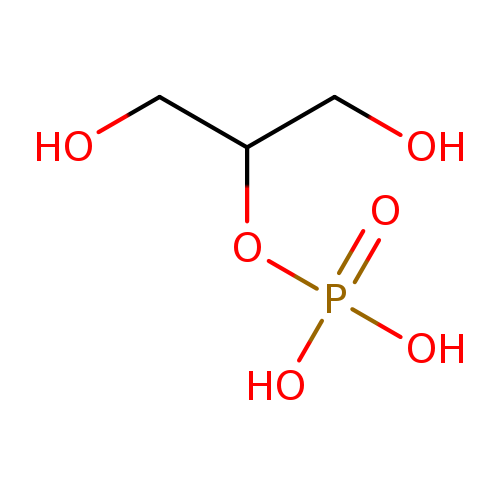
Glycerol 2-phosphate, also known as beta-glycerophosphate, belongs to the class of organic compounds known as glycerophosphates. Glycerophosphates are compounds containing a glycerol linked to a phosphate group. Glycerol 2-phosphate is possibly soluble (in water) and an extremely weak basic (essentially neutral) compound (based on its pKa). Glycerol 2-phosphate exists in all living species, ranging from bacteria to humans.
belongs to the class of organic compounds known as glycerophosphates. Glycerophosphates are compounds containing a glycerol linked to a phosphate group.
To elucidate potential interactions between gut microbial taxa and fecal metabolites, we performed an integrated Spearman correlation analysis combining the top 15 differential genera with the top 35 differential metabolites (|r| > 0.6, p < 0.05).
Written in the paper as “Glycerol 2-phosphate” and “fecal”
Among them, glycerol 2-phosphate and 24(28)-dehydroergosterol showed perfect classification performance (AUC = 1.000), and were mainly involved in membrane lipid remodeling and redox regulation.
Written in the paper as “glycerol 2-phosphate” and “redox regulation”
Involved in
generation of precursor metabolites and energy GO:0006091
The chemical reactions and pathways resulting in the formation of precursor metabolites, substances from which energy is derived, and any process involved in the liberation of energy from these substances.
Glycerol 2-phosphate (glycerol-3-phosphate) serves as a key intermediate linking glycolysis to phospholipid metabolism, supplying substrates for membrane synthesis and remodeling, while also participating in respiratory chain electron transfer to regulate energy metabolism and redox balance.
Written in the paper as “glycerol 2-phosphate” and “energy metabolism”
The chemical reactions and pathways resulting in the breakdown of a carbohydrate into pyruvate, with the concomitant production of a small amount of ATP and the reduction of NAD(P) to NAD(P)H. Glycolysis begins with the metabolism of a carbohydrate to generate products that can enter the pathway and ends with the production of pyruvate. Pyruvate may be converted to acetyl-coenzyme A, ethanol, lactate, or other small molecules.
Glycerol 2-phosphate (glycerol-3-phosphate) serves as a key intermediate linking glycolysis to phospholipid metabolism, supplying substrates for membrane synthesis and remodeling, while also participating in respiratory chain electron transfer to regulate energy metabolism and redox balance.
Written in the paper as “glycerol 2-phosphate” and “glycolysis”
Among them, glycerol 2-phosphate and 24(28)-dehydroergosterol showed perfect classification performance (AUC = 1.000), and were mainly involved in membrane lipid remodeling and redox regulation.
Written in the paper as “glycerol 2-phosphate” and “membrane lipid remodeling”
Glycerol 2-phosphate (glycerol-3-phosphate) serves as a key intermediate linking glycolysis to phospholipid metabolism, supplying substrates for membrane synthesis and remodeling, while also participating in respiratory chain electron transfer to regulate energy metabolism and redox balance.
Written in the paper as “glycerol 2-phosphate” and “membrane synthesis”
Glycerol 2-phosphate (glycerol-3-phosphate) serves as a key intermediate linking glycolysis to phospholipid metabolism, supplying substrates for membrane synthesis and remodeling, while also participating in respiratory chain electron transfer to regulate energy metabolism and redox balance.
Written in the paper as “glycerol 2-phosphate” and “phospholipid metabolism”
A process in which a series of electron carriers operate together to transfer electrons from donors such as NADH and FADH2 to any of several different terminal electron acceptors to generate a transmembrane electrochemical gradient.
Glycerol 2-phosphate (glycerol-3-phosphate) serves as a key intermediate linking glycolysis to phospholipid metabolism, supplying substrates for membrane synthesis and remodeling, while also participating in respiratory chain electron transfer to regulate energy metabolism and redox balance.
Written in the paper as “glycerol 2-phosphate” and “respiratory chain electron transfer”
In total, 10 different important metabolites were found for pH value, of which only glycerol-2-phosphate and glycine were found to be in each inner cross-validation run.
Written in the paper as “glycerol-2-phosphate” and “pH value”
HT cows were enriched in Oscillospiraceae and Ruminococcaceae associated with energy metabolism and antioxidant defense, and exhibited higher levels of glycerol 2-phosphate and 24(28)-dehydroergosterol metabolites that enhance membrane stability, energy balance, and oxidative protection.
Written in the paper as “glycerol 2-phosphate” and “energy balance”
HT cows were enriched in Oscillospiraceae and Ruminococcaceae associated with energy metabolism and antioxidant defense, and exhibited higher levels of glycerol 2-phosphate and 24(28)-dehydroergosterol metabolites that enhance membrane stability, energy balance, and oxidative protection.
Written in the paper as “glycerol 2-phosphate” and “enhance membrane stability”
HT cows were enriched in Oscillospiraceae and Ruminococcaceae associated with energy metabolism and antioxidant defense, and exhibited higher levels of glycerol 2-phosphate and 24(28)-dehydroergosterol metabolites that enhance membrane stability, energy balance, and oxidative protection.
Written in the paper as “glycerol 2-phosphate” and “oxidative protection”
Melzer N, Wittenburg D, Hartwig S, Jakubowski S, Kesting U, Willmitzer L, Lisec J, Reinsch N, Repsilber D: Investigating associations between milk metabolite profiles and milk traits of Holstein cows. J Dairy Sci. 2013 Mar;96(3):1521-34. doi: 10.3168/jds.2012-5743. [PubMed:23438684 ]
Kurt J. Boudonck, Matthew W. Mitchell, Jacob Wulff and John A. Ryals (2009). Kurt J. Boudonck, Matthew W. Mitchell, Jacob Wulff, John A. Ryals. Characterization of the biochemical variability of bovine milk using metabolomics. Metabolomics (2009) 5:375-386 doi: 10.1007/s11306-009-0160-8. Metabolomics.
Kurt J. Boudonck, Matthew W. Mitchell, Jacob Wulff, John A. Ryals (2009). Characterization of the biochemical variability of bovine milk using metabolomics. Metabolomics.