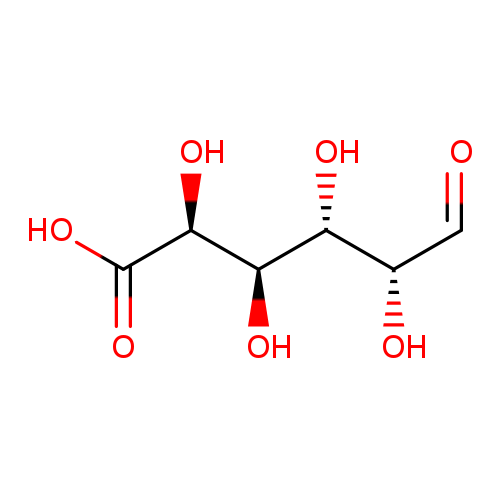
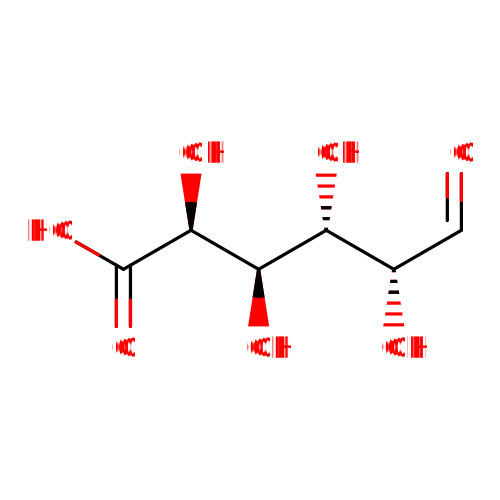
Aldehydo-D-galacturonate, also known as D-galacturonic acid or calcium pectate, belongs to the class of organic compounds known as glucuronic acid derivatives. Glucuronic acid derivatives are compounds containing a glucuronic acid moiety (or a derivative), which consists of a glucose moiety with the C6 carbon oxidized to a carboxylic acid. Aldehydo-D-galacturonate is possibly soluble (in water) and an extremely weak basic (essentially neutral) compound (based on its pKa). Aldehydo-D-galacturonate exists in all living species, ranging from bacteria to humans.
belongs to the class of organic compounds known as glucuronic acid derivatives. Glucuronic acid derivatives are compounds containing a glucuronic acid moiety (or a derivative), which consists of a glucose moiety with the C6 carbon oxidized to a carboxylic acid.
Despite these observations, a decline in sugar degradation (such as D-galactose, purine ribonucleosides, glycogen, D-galacturonate) and a reduction in the production of vitamin B12 and peptidoglycan maturation were observed in the ninth week following ceftiofur treatment.
Written in the paper as “D-galacturonate” and “sugar degradation”
In addition to these genes associated with mucus-derived carbohydrate assimilation, genes encoding proteins involved in the transport and/or utilization of arabinose (araABDFG), fructose (fruABK), gluconate (gntKPTU) and hexuronate (galacturonate and glucuronate) (uxaABC and uxuAB) also exhibited increased expression in the posterior compartments.
Written in the paper as “galacturonate” and “transport and/or utilization of hexuronate”
A heteropolysaccharide containing a large proportion of <small>D</small>-galactopyranosyluronic acid residues in α-(1→4) linkage, of which the hydroxy groups at positions C2 and C3 may be acetylated and carboxy groups at positions C6 may be esterified to varying degrees by methyl groups or be partially or completely converted into salts.
Uronic acids are present at varying levels in different types of plants as constituents of polysaccharides, particularly pectin10; galacturonic acid is the main uronic acid in pectin11.
Written in the paper as “galacturonic acid” and “pectin”