Record Information
Version1.0
Creation Date2016-10-03 17:33:01 UTC
Update Date2020-05-21 16:26:25 UTC
BMDB IDBMDB0008965
Secondary Accession Numbers
  • BMDB08965
Metabolite Identification
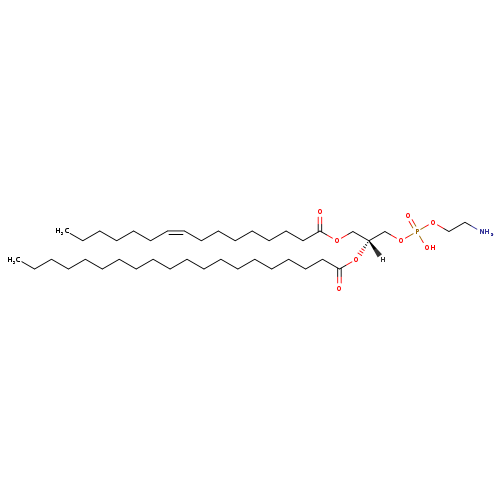
Common NamePE(16:1(9Z)/20:0)
DescriptionPE(16:1(9Z)/20:0), also known as PE(36:1) or PE(16:1/20:0), belongs to the class of organic compounds known as phosphatidylethanolamines. These are glycerophosphoetahnolamines in which two fatty acids are bonded to the glycerol moiety through ester linkages. Thus, PE(16:1(9Z)/20:0) is considered to be a glycerophosphoethanolamine lipid molecule. PE(16:1(9Z)/20:0) is a very hydrophobic molecule, practically insoluble (in water), and relatively neutral. PE(16:1(9Z)/20:0) exists in all eukaryotes, ranging from yeast to humans. PE(16:1(9Z)/20:0) participates in a number of enzymatic reactions, within cattle. In particular, PE(16:1(9Z)/20:0) can be biosynthesized from PS(16:1(9Z)/20:0) through the action of the enzyme phosphatidylserine decarboxylase. Furthermore, Cytidine monophosphate and PE(16:1(9Z)/20:0) can be biosynthesized from CDP-ethanolamine and DG(16:1(9Z)/20:0/0:0); which is catalyzed by the enzyme choline/ethanolaminephosphotransferase. Furthermore, Cytidine monophosphate and PE(16:1(9Z)/20:0) can be biosynthesized from CDP-ethanolamine and DG(16:1(9Z)/20:0/0:0); which is mediated by the enzyme choline/ethanolaminephosphotransferase. Finally, PE(16:1(9Z)/20:0) can be biosynthesized from PS(16:1(9Z)/20:0); which is mediated by the enzyme phosphatidylserine decarboxylase. In cattle, PE(16:1(9Z)/20:0) is involved in a couple of metabolic pathways, which include phosphatidylethanolamine biosynthesis pe(16:1(9Z)/20:0) pathway and phosphatidylcholine biosynthesis PC(16:1(9Z)/20:0) pathway.
Structure
Thumb
Synonyms
ValueSource
PE(36:1)HMDB
Phophatidylethanolamine(16:1/20:0)HMDB
Phophatidylethanolamine(36:1)HMDB
PE(16:1/20:0)HMDB
1-Palmitoleoyl-2-arachidonyl-sn-glycero-3-phosphoethanolamineHMDB
GPEtn(36:1)HMDB
1-(9Z-Hexadecenoyl)-2-eicosanoyl-sn-glycero-3-phosphoethanolamineHMDB
GPEtn(16:1/20:0)HMDB
PE(16:1(9Z)/20:0)Lipid Annotator
Chemical FormulaC41H80NO8P
Average Molecular Weight746.0496
Monoisotopic Molecular Weight745.562155053
IUPAC Name(2-aminoethoxy)[(2R)-3-[(9Z)-hexadec-9-enoyloxy]-2-(icosanoyloxy)propoxy]phosphinic acid
Traditional Name2-aminoethoxy(2R)-3-[(9Z)-hexadec-9-enoyloxy]-2-(icosanoyloxy)propoxyphosphinic acid
CAS Registry NumberNot Available
SMILES
[H][C@@](COC(=O)CCCCCCC\C=C/CCCCCC)(COP(O)(=O)OCCN)OC(=O)CCCCCCCCCCCCCCCCCCC
InChI Identifier
InChI=1S/C41H80NO8P/c1-3-5-7-9-11-13-15-17-18-19-20-22-24-26-28-30-32-34-41(44)50-39(38-49-51(45,46)48-36-35-42)37-47-40(43)33-31-29-27-25-23-21-16-14-12-10-8-6-4-2/h14,16,39H,3-13,15,17-38,42H2,1-2H3,(H,45,46)/b16-14-/t39-/m1/s1
InChI KeyDWDUPRRUGYDGQF-QRMPNUHKSA-N
Chemical Taxonomy
Description belongs to the class of organic compounds known as phosphatidylethanolamines. These are glycerophosphoetahnolamines in which two fatty acids are bonded to the glycerol moiety through ester linkages.
KingdomOrganic compounds
Super ClassLipids and lipid-like molecules
ClassGlycerophospholipids
Sub ClassGlycerophosphoethanolamines
Direct ParentPhosphatidylethanolamines
Alternative Parents
Substituents
  • Diacylglycero-3-phosphoethanolamine
  • Phosphoethanolamine
  • Fatty acid ester
  • Dialkyl phosphate
  • Dicarboxylic acid or derivatives
  • Organic phosphoric acid derivative
  • Phosphoric acid ester
  • Alkyl phosphate
  • Fatty acyl
  • Amino acid or derivatives
  • Carboxylic acid ester
  • Carboxylic acid derivative
  • Organopnictogen compound
  • Organic oxygen compound
  • Organooxygen compound
  • Organonitrogen compound
  • Amine
  • Primary aliphatic amine
  • Organic nitrogen compound
  • Primary amine
  • Carbonyl group
  • Organic oxide
  • Hydrocarbon derivative
  • Aliphatic acyclic compound
Molecular FrameworkAliphatic acyclic compounds
External Descriptors
Ontology
StatusExpected but not Quantified
Origin
  • Endogenous
  • Exogenous
BiofunctionNot Available
ApplicationNot Available
Cellular locations
  • Cell membrane
  • Intracellular membrane
  • Membrane
Physical Properties
StateSolid
Experimental Properties
PropertyValueReference
Melting PointNot AvailableNot Available
Boiling PointNot AvailableNot Available
Water SolubilityNot AvailableNot Available
LogPNot AvailableNot Available
Predicted Properties
PropertyValueSource
logP8.84ALOGPS
logP11.87ChemAxon
logS-7.1ALOGPS
pKa (Strongest Acidic)1.87ChemAxon
pKa (Strongest Basic)10ChemAxon
Physiological Charge0ChemAxon
Hydrogen Acceptor Count5ChemAxon
Hydrogen Donor Count2ChemAxon
Polar Surface Area134.38 ŲChemAxon
Rotatable Bond Count42ChemAxon
Refractivity210.52 m³·mol⁻¹ChemAxon
Polarizability92.38 ųChemAxon
Number of Rings0ChemAxon
BioavailabilityYesChemAxon
Rule of FiveYesChemAxon
Ghose FilterYesChemAxon
Veber's RuleYesChemAxon
MDDR-like RuleYesChemAxon
Spectra
Spectra
Spectrum TypeDescriptionSplash Key
Predicted GC-MSPredicted GC-MS Spectrum - GC-MS (Non-derivatized) - 70eV, PositiveNot AvailableView in JSpectraViewer
Predicted LC-MS/MSPredicted LC-MS/MS Spectrum - 10V, Negativesplash10-0006-0011000900-a39ff30e99677b6e13efView in MoNA
Predicted LC-MS/MSPredicted LC-MS/MS Spectrum - 20V, Negativesplash10-0006-0011000900-a39ff30e99677b6e13efView in MoNA
Predicted LC-MS/MSPredicted LC-MS/MS Spectrum - 40V, Negativesplash10-0w2c-0399410600-f2b151d10f605095af4bView in MoNA
Predicted LC-MS/MSPredicted LC-MS/MS Spectrum - 10V, Positivesplash10-0002-0000001900-7176fc363ec50a2c3ca5View in MoNA
Predicted LC-MS/MSPredicted LC-MS/MS Spectrum - 20V, Positivesplash10-0a4j-0003419700-1cf5d6a16343122865c5View in MoNA
Predicted LC-MS/MSPredicted LC-MS/MS Spectrum - 40V, Positivesplash10-0a4i-0003419300-72c431686ca81c1bd3fcView in MoNA
Predicted LC-MS/MSPredicted LC-MS/MS Spectrum - 10V, Positivesplash10-014i-0000001900-5c10bab26c2e0a3f80b0View in MoNA
Predicted LC-MS/MSPredicted LC-MS/MS Spectrum - 20V, Positivesplash10-016r-0000001900-607ffbebec54dace7f08View in MoNA
Predicted LC-MS/MSPredicted LC-MS/MS Spectrum - 40V, Positivesplash10-004i-0100201900-b20355fea4fb8f148959View in MoNA
Predicted LC-MS/MSPredicted LC-MS/MS Spectrum - 10V, Negativesplash10-0006-0011000900-5d8980c43b3964edb7a1View in MoNA
Predicted LC-MS/MSPredicted LC-MS/MS Spectrum - 20V, Negativesplash10-0006-0011000900-5d8980c43b3964edb7a1View in MoNA
Predicted LC-MS/MSPredicted LC-MS/MS Spectrum - 40V, Negativesplash10-0w2c-0399410600-97c7ec8f96237469f456View in MoNA
Predicted LC-MS/MSPredicted LC-MS/MS Spectrum - 10V, Positivesplash10-0002-0000001900-f16c013a0ef8ad1e73b0View in MoNA
Predicted LC-MS/MSPredicted LC-MS/MS Spectrum - 20V, Positivesplash10-0a4j-0003419700-ba63788cb17b30ad3e7fView in MoNA
Predicted LC-MS/MSPredicted LC-MS/MS Spectrum - 40V, Positivesplash10-0a4i-0003419300-9157ce67b8f77815cd1cView in MoNA
1D NMR13C NMR Spectrum (1D, 100 MHz, H2O, predicted)Not AvailableView in JSpectraViewer
1D NMR1H NMR Spectrum (1D, 100 MHz, H2O, predicted)Not AvailableView in JSpectraViewer
1D NMR13C NMR Spectrum (1D, 1000 MHz, H2O, predicted)Not AvailableView in JSpectraViewer
1D NMR1H NMR Spectrum (1D, 1000 MHz, H2O, predicted)Not AvailableView in JSpectraViewer
1D NMR13C NMR Spectrum (1D, 200 MHz, H2O, predicted)Not AvailableView in JSpectraViewer
1D NMR1H NMR Spectrum (1D, 200 MHz, H2O, predicted)Not AvailableView in JSpectraViewer
1D NMR13C NMR Spectrum (1D, 300 MHz, H2O, predicted)Not AvailableView in JSpectraViewer
1D NMR1H NMR Spectrum (1D, 300 MHz, H2O, predicted)Not AvailableView in JSpectraViewer
1D NMR13C NMR Spectrum (1D, 400 MHz, H2O, predicted)Not AvailableView in JSpectraViewer
1D NMR1H NMR Spectrum (1D, 400 MHz, H2O, predicted)Not AvailableView in JSpectraViewer
1D NMR13C NMR Spectrum (1D, 500 MHz, H2O, predicted)Not AvailableView in JSpectraViewer
1D NMR1H NMR Spectrum (1D, 500 MHz, H2O, predicted)Not AvailableView in JSpectraViewer
1D NMR13C NMR Spectrum (1D, 600 MHz, H2O, predicted)Not AvailableView in JSpectraViewer
1D NMR1H NMR Spectrum (1D, 600 MHz, H2O, predicted)Not AvailableView in JSpectraViewer
1D NMR13C NMR Spectrum (1D, 700 MHz, H2O, predicted)Not AvailableView in JSpectraViewer
1D NMR1H NMR Spectrum (1D, 700 MHz, H2O, predicted)Not AvailableView in JSpectraViewer
1D NMR13C NMR Spectrum (1D, 800 MHz, H2O, predicted)Not AvailableView in JSpectraViewer
1D NMR1H NMR Spectrum (1D, 800 MHz, H2O, predicted)Not AvailableView in JSpectraViewer
1D NMR13C NMR Spectrum (1D, 900 MHz, H2O, predicted)Not AvailableView in JSpectraViewer
1D NMR1H NMR Spectrum (1D, 900 MHz, H2O, predicted)Not AvailableView in JSpectraViewer
Biological Properties
Cellular Locations
  • Cell membrane
  • Intracellular membrane
  • Membrane
Biospecimen Locations
  • All Tissues
  • Brain
Pathways
Normal Concentrations
BiospecimenStatusValueAgeSexConditionReferenceDetails
All TissuesExpected but not QuantifiedNot QuantifiedNot SpecifiedNot SpecifiedNormal
  • Not Applicable
details
BrainExpected but not QuantifiedNot QuantifiedNot SpecifiedNot SpecifiedNormal
  • Not Applicable
details
Abnormal Concentrations
Not Available
HMDB IDHMDB0008965
DrugBank IDNot Available
Phenol Explorer Compound IDNot Available
FooDB IDFDB026155
KNApSAcK IDNot Available
Chemspider IDNot Available
KEGG Compound IDNot Available
BioCyc IDNot Available
BiGG IDNot Available
Wikipedia LinkNot Available
METLIN IDNot Available
PubChem Compound52924232
PDB IDNot Available
ChEBI IDNot Available
References
Synthesis ReferenceNot Available
Material Safety Data Sheet (MSDS)Not Available
General ReferencesNot Available

Enzymes

General function:
Involved in ethanolaminephosphotransferase activity
Specific function:
Catalyzes phosphatidylethanolamine biosynthesis from CDP-ethanolamine. It thereby plays a central role in the formation and maintenance of vesicular membranes. Involved in the foramtion of phosphatidylethanolamine via 'Kennedy' pathway (By similarity).
Gene Name:
SELENOI
Uniprot ID:
Q17QM4
Molecular weight:
45214.0
Reactions
CDP-Ethanolamine + DG(16:1(9Z)/20:0/0:0) → Cytidine monophosphate + PE(16:1(9Z)/20:0)details