| Record Information |
|---|
| Version | 1.0 |
|---|
| Creation Date | 2016-10-03 17:50:13 UTC |
|---|
| Update Date | 2020-05-11 19:45:51 UTC |
|---|
| BMDB ID | BMDB0009783 |
|---|
| Secondary Accession Numbers | |
|---|
| Metabolite Identification |
|---|
| Common Name | PI(16:0/18:1(9Z)) |
|---|
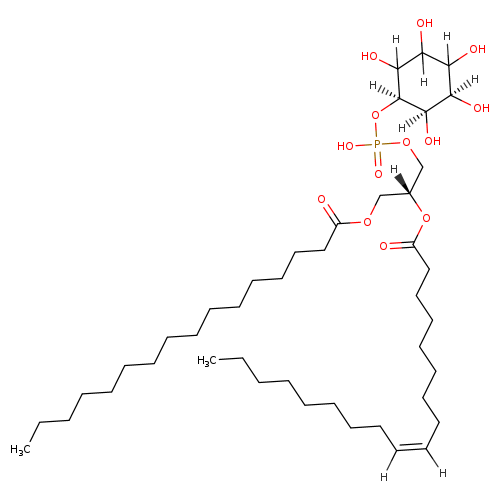
| Description | PI(16:0/18:1(9Z))is a phosphatidylinositol. Phosphatidylinositols are important lipids, both as a key membrane constituent and as a participant in essential metabolic processes, both directly and via a number of metabolites. Phosphatidylinositols are acidic (anionic) phospholipids that consist of a phosphatidic acid backbone, linked via the phosphate group to inositol (hexahydroxycyclohexane). Phosphatidylinositols can have many different combinations of fatty acids of varying lengths and saturation attached at the C-1 and C-2 positions. Fatty acids containing 18 and 20 carbons are the most common.PI(16:0/18:1(9Z)), in particular, consists of one hexadecanoyl chain to the C-1 atom, and one 9Z-octadecenoyl to the C-2 atom. The inositol group that is part of every phosphatidylinositol lipid is covalently linked to the phosphate group that acts as a bridge to the lipid tail. In most organisms, the stereochemical form of this inositol is myo-D-inositol (with one axial hydroxyl in position 2 with the remainder equatorial), although other forms can be found in certain plant phosphatidylinositols. Phosphatidylinositol can be phosphorylated by a number of different kinases that place the phosphate moiety on positions 4 and 5 of the inositol ring, although position 3 can also be phosphorylated by a specific kinase. Seven different isomers are known, but the most important in both quantitative and biological terms are phosphatidylinositol 4-phosphate and phosphatidylinositol 4,5-bisphosphate. Phosphatidylinositol and the phosphatidylinositol phosphates are the main source of diacylglycerols that serve as signaling molecules, via the action of phospholipase C enzymes. While most phospholipids have a saturated fatty acid on C-1 and an unsaturated fatty acid on C-2 of the glycerol backbone, the fatty acid distribution at the C-1 and C-2 positions of glycerol within phospholipids is continually in flux, owing to phospholipid degradation and the continuous phospholipid remodeling that occurs while these molecules are in membranes. PIs contain almost exclusively stearic acid at carbon 1 and arachidonic acid at carbon 2. PIs composed exclusively of non-phosphorylated inositol exhibit a net charge of -1 at physiological pH. Molecules with phosphorylated inositol (such as PIP, PIP2, PIP3, etc.) are termed polyphosphoinositides. The polyphosphoinositides are important intracellular transducers of signals emanating from the plasma membrane. The synthesis of PI involves CDP-activated 1,2-diacylglycerol condensation with myo-inositol. |
|---|
| Structure | |
|---|
| Synonyms | | Value | Source |
|---|
| [(2R)-3-(Hexadecanoyloxy)-2-[(9Z)-octadec-9-enoyloxy]propoxy]({[(1S,2R,3R)-2,3,4,5,6-pentahydroxycyclohexyl]oxy})phosphinate | Generator |
|
|---|
| Chemical Formula | C43H81O13P |
|---|
| Average Molecular Weight | 837.082 |
|---|
| Monoisotopic Molecular Weight | 836.541479666 |
|---|
| IUPAC Name | [(2R)-3-(hexadecanoyloxy)-2-[(9Z)-octadec-9-enoyloxy]propoxy]({[(1S,2R,3R)-2,3,4,5,6-pentahydroxycyclohexyl]oxy})phosphinic acid |
|---|
| Traditional Name | (2R)-3-(hexadecanoyloxy)-2-[(9Z)-octadec-9-enoyloxy]propoxy([(1S,2R,3R)-2,3,4,5,6-pentahydroxycyclohexyl]oxy)phosphinic acid |
|---|
| CAS Registry Number | Not Available |
|---|
| SMILES | [H]\C(CCCCCCCC)=C(/[H])CCCCCCCC(=O)O[C@]([H])(COC(=O)CCCCCCCCCCCCCCC)COP(O)(=O)O[C@@]1([H])C([H])(O)C([H])(O)C([H])(O)[C@@]([H])(O)[C@@]1([H])O |
|---|
| InChI Identifier | InChI=1S/C43H81O13P/c1-3-5-7-9-11-13-15-17-18-20-22-24-26-28-30-32-37(45)55-35(34-54-57(51,52)56-43-41(49)39(47)38(46)40(48)42(43)50)33-53-36(44)31-29-27-25-23-21-19-16-14-12-10-8-6-4-2/h17-18,35,38-43,46-50H,3-16,19-34H2,1-2H3,(H,51,52)/b18-17-/t35-,38?,39-,40?,41-,42?,43-/m1/s1 |
|---|
| InChI Key | PDLAMJKMOKWLAJ-ZLUUMHEQSA-N |
|---|
| Chemical Taxonomy |
|---|
| Description | belongs to the class of organic compounds known as phosphatidylinositols. These are glycerophosphoinositols where the glycerol is esterified with two fatty acids. |
|---|
| Kingdom | Organic compounds |
|---|
| Super Class | Lipids and lipid-like molecules |
|---|
| Class | Glycerophospholipids |
|---|
| Sub Class | Glycerophosphoinositols |
|---|
| Direct Parent | Phosphatidylinositols |
|---|
| Alternative Parents | |
|---|
| Substituents | - Diacylglycerophosphoinositol
- Inositol phosphate
- Dialkyl phosphate
- Fatty acid ester
- Cyclohexanol
- Fatty acyl
- Alkyl phosphate
- Phosphoric acid ester
- Organic phosphoric acid derivative
- Dicarboxylic acid or derivatives
- Cyclitol or derivatives
- Cyclic alcohol
- Secondary alcohol
- Carboxylic acid ester
- Polyol
- Carboxylic acid derivative
- Organic oxygen compound
- Organic oxide
- Hydrocarbon derivative
- Organooxygen compound
- Carbonyl group
- Alcohol
- Aliphatic homomonocyclic compound
|
|---|
| Molecular Framework | Aliphatic homomonocyclic compounds |
|---|
| External Descriptors | Not Available |
|---|
| Ontology |
|---|
| Status | Expected but not Quantified |
|---|
| Origin | |
|---|
| Biofunction | Not Available |
|---|
| Application | Not Available |
|---|
| Cellular locations | - Cell membrane
- Intracellular membrane
- Membrane
|
|---|
| Physical Properties |
|---|
| State | Solid |
|---|
| Experimental Properties | | Property | Value | Reference |
|---|
| Melting Point | Not Available | Not Available | | Boiling Point | Not Available | Not Available | | Water Solubility | Not Available | Not Available | | LogP | Not Available | Not Available |
|
|---|
| Predicted Properties | |
|---|
| Spectra |
|---|
| Spectra | |
|---|