| Record Information |
|---|
| Version | 1.0 |
|---|
| Creation Date | 2016-10-03 18:09:35 UTC |
|---|
| Update Date | 2020-05-11 19:12:03 UTC |
|---|
| BMDB ID | BMDB0010576 |
|---|
| Secondary Accession Numbers | |
|---|
| Metabolite Identification |
|---|
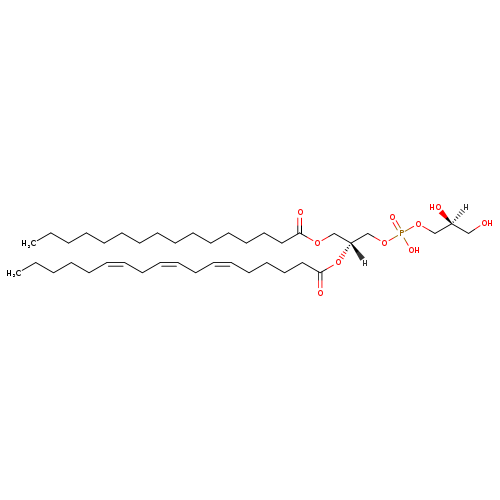
| Common Name | PG(16:0/18:3(6Z,9Z,12Z)) |
|---|
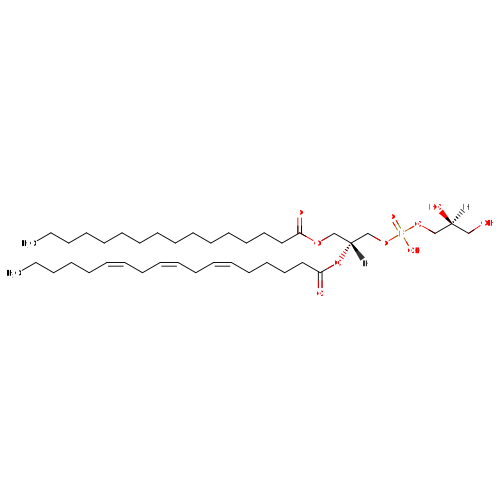
| Description | PG(16:0/18:3(6Z,9Z,12Z)) is a phosphatidylglycerol. Phosphatidylglycerols consist of a glycerol 3-phosphate backbone esterified to either saturated or unsaturated fatty acids on carbons 1 and 2. As is the case with diacylglycerols, phosphatidylglycerols can have many different combinations of fatty acids of varying lengths and saturation attached to the C-1 and C-2 positions. PG(16:0/18:3(6Z,9Z,12Z)), in particular, consists of one hexadecanoyl chain to the C-1 atom, and one 6Z,9Z,12Z-octadecatrienoyl to the C-2 atom. In E. coli glycerophospholipid metabolism, phosphatidylglycerol is formed from phosphatidic acid (1,2-diacyl-sn-glycerol 3-phosphate) by a sequence of enzymatic reactions that proceeds via two intermediates, cytidine diphosphate diacylglycerol (CDP-diacylglycerol) and phosphatidylglycerophosphate (PGP, a phosphorylated phosphatidylglycerol). Phosphatidylglycerols, along with CDP-diacylglycerol, also serve as precursor molecules for the synthesis of cardiolipin, a phospholipid found in membranes. |
|---|
| Structure | |
|---|
| Synonyms | | Value | Source |
|---|
| 1-Hexadecanoyl-2-(6Z,9Z,12Z-octadecatrienoyl)-sn-glycero-3-phospho-(1'-glycerol) | HMDB | | 1-Palmitoyl-2-g-linolenoyl-sn-glycero-3-phosphoglycerol | HMDB | | 1-Palmitoyl-2-gamma-linolenoyl-sn-glycero-3-phosphoglycerol | HMDB | | GPG(16:0/18:3) | HMDB | | GPG(16:0/18:3N6) | HMDB | | GPG(16:0/18:3W6) | HMDB | | GPG(34:3) | HMDB | | PG(16:0/18:3) | HMDB | | PG(16:0/18:3N6) | HMDB | | PG(16:0/18:3W6) | HMDB | | PG(34:3) | HMDB | | Phosphatidylglycerol(16:0/18:3) | HMDB | | Phosphatidylglycerol(16:0/18:3n6) | HMDB | | Phosphatidylglycerol(16:0/18:3W6) | HMDB | | Phosphatidylglycerol(34:3) | HMDB | | 1-Hexadecanoyl-2-(6Z,9Z,12Z-octadecatrienoyl)-sn-glycero-3-phosphoglycerol | HMDB | | PG(16:0/18:3(6Z,9Z,12Z)) | Lipid Annotator |
|
|---|
| Chemical Formula | C40H73O10P |
|---|
| Average Molecular Weight | 744.9754 |
|---|
| Monoisotopic Molecular Weight | 744.494135068 |
|---|
| IUPAC Name | [(2S)-2,3-dihydroxypropoxy][(2R)-3-(hexadecanoyloxy)-2-[(6Z,9Z,12Z)-octadeca-6,9,12-trienoyloxy]propoxy]phosphinic acid |
|---|
| Traditional Name | (2S)-2,3-dihydroxypropoxy(2R)-3-(hexadecanoyloxy)-2-[(6Z,9Z,12Z)-octadeca-6,9,12-trienoyloxy]propoxyphosphinic acid |
|---|
| CAS Registry Number | Not Available |
|---|
| SMILES | [H][C@](O)(CO)COP(O)(=O)OC[C@@]([H])(COC(=O)CCCCCCCCCCCCCCC)OC(=O)CCCC\C=C/C\C=C/C\C=C/CCCCC |
|---|
| InChI Identifier | InChI=1S/C40H73O10P/c1-3-5-7-9-11-13-15-17-18-20-22-24-26-28-30-32-40(44)50-38(36-49-51(45,46)48-34-37(42)33-41)35-47-39(43)31-29-27-25-23-21-19-16-14-12-10-8-6-4-2/h11,13,17-18,22,24,37-38,41-42H,3-10,12,14-16,19-21,23,25-36H2,1-2H3,(H,45,46)/b13-11-,18-17-,24-22-/t37-,38+/m0/s1 |
|---|
| InChI Key | MVHBCRUZHMRQHX-UIWSMAGISA-N |
|---|
| Chemical Taxonomy |
|---|
| Description | belongs to the class of organic compounds known as phosphatidylglycerols. These are glycerophosphoglycerols in which two fatty acids are bonded to the 1-glycerol moiety through ester linkages. As is the case with diacylglycerols, phosphatidylglycerols can have many different combinations of fatty acids of varying lengths and saturation attached to the C-1 and C-2 positions. |
|---|
| Kingdom | Organic compounds |
|---|
| Super Class | Lipids and lipid-like molecules |
|---|
| Class | Glycerophospholipids |
|---|
| Sub Class | Glycerophosphoglycerols |
|---|
| Direct Parent | Phosphatidylglycerols |
|---|
| Alternative Parents | |
|---|
| Substituents | - 1,2-diacylglycerophosphoglycerol
- Fatty acid ester
- Dialkyl phosphate
- Dicarboxylic acid or derivatives
- Organic phosphoric acid derivative
- Phosphoric acid ester
- Alkyl phosphate
- Fatty acyl
- 1,2-diol
- Carboxylic acid ester
- Secondary alcohol
- Carboxylic acid derivative
- Organic oxide
- Organooxygen compound
- Alcohol
- Organic oxygen compound
- Primary alcohol
- Carbonyl group
- Hydrocarbon derivative
- Aliphatic acyclic compound
|
|---|
| Molecular Framework | Aliphatic acyclic compounds |
|---|
| External Descriptors | |
|---|
| Ontology |
|---|
| Status | Expected but not Quantified |
|---|
| Origin | |
|---|
| Biofunction | Not Available |
|---|
| Application | Not Available |
|---|
| Cellular locations | - Cell membrane
- Intracellular membrane
- Membrane
|
|---|
| Physical Properties |
|---|
| State | Solid |
|---|
| Experimental Properties | | Property | Value | Reference |
|---|
| Melting Point | Not Available | Not Available | | Boiling Point | Not Available | Not Available | | Water Solubility | Not Available | Not Available | | LogP | Not Available | Not Available |
|
|---|
| Predicted Properties | |
|---|
| Spectra |
|---|
| Spectra | |
|---|