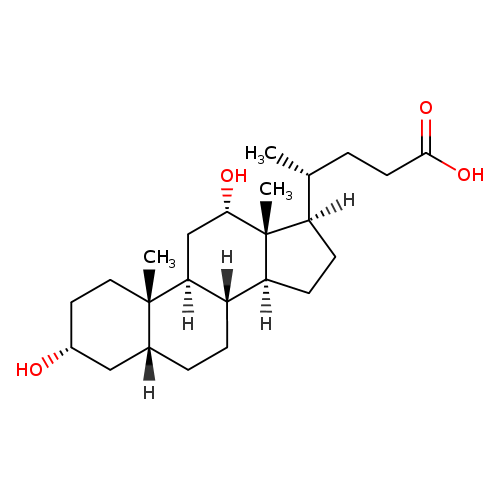
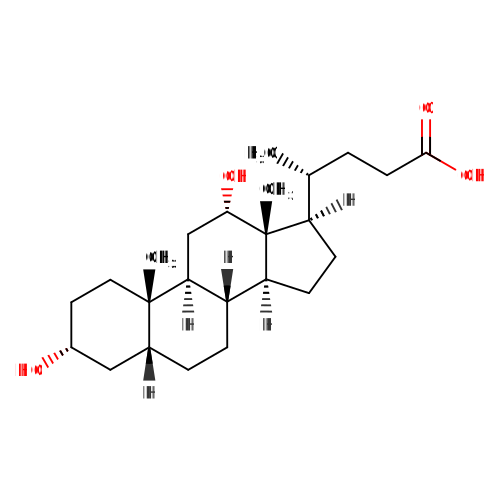
Deoxycholic acid, also known as deoxycholate or acid, deoxycholic, belongs to the class of organic compounds known as dihydroxy bile acids, alcohols and derivatives. Dihydroxy bile acids, alcohols and derivatives are compounds containing or derived from a bile acid or alcohol, and which bears exactly two carboxylic acid groups. Deoxycholic acid is a very hydrophobic molecule, practically insoluble (in water), and relatively neutral.
belongs to the class of organic compounds known as dihydroxy bile acids, alcohols and derivatives. Dihydroxy bile acids, alcohols and derivatives are compounds containing or derived from a bile acid or alcohol, and which bears exactly two carboxylic acid groups.
Deoxycholic acid is a steroid and one of the main components of circulating bile acid, which plays an important role in bile secretion (Funabashi et al., 2020).
Written in the paper as “Deoxycholic acid” and “bile”
The serum deoxycholic acid was positively correlated with glucosylceramide (d18:1/16:0), hydroxyphenyllactic acid, galactosylceramide (d18:1/14:0) and tetrahydroneopterin.
Written in the paper as “deoxycholic acid” and “serum”
Gordonibacter and Adlercreutzia were negatively correlated with jejunal acetate, propionate, blood 5-HT, GLP-1, T3, and T4, but were positively correlated with DCA and LCA (Fig. 8B; P < 0.05).
Written in the paper as “deoxycholic acid” and “jejunal fluid”
The secondary bile acids in the jejunum, including deoxycholic acid (DCA; Kit No. YT0161-VA) and lithocholic acid (LCA; Kit No. YT14771-A), were quantified using commercially available ELISA kits (Jiangsu Enzyme Immuno Industry Co., Ltd., China).
Written in the paper as “deoxycholic acid” and “jejunum”
Deoxycholic acid-mediated activation of the G protein-coupled receptor reduces inflammation by inhibiting the NF-kB and NLRP3 pathways and improves the integrity of the blood-milk barrier, thereby reducing mastitis (57, 58).
Written in the paper as “Deoxycholic acid” and “mastitis”
A reduction in beneficial metabolites, such as butyrate, deoxycholic acid (DCA), and 5-hydroxyindole acetic acid (5-HIAA), also plays a crucial role in regulating mastitis progression by enhancing barrier integrity and suppressing inflammatory responses [20, 22-24].
Written in the paper as “deoxycholic acid” and “Mastitis”
Cows with subacute ruminal acidosis (SARA)-associated mastitis have reduced circulating deoxycholic acid (DCA) levels, and DCA supplementation alleviates S. aureus-induced mastitis by activating TGR5, inhibiting NF-kB and NLRP3, and improving blood-milk barrier integrity [24].
Written in the paper as “deoxycholic acid” and “mastitis”
Zhao, C. et al. [61] showed that SARA cows exhibited significantly reduced levels of both primary bile acid cholic acid (CA) and secondary bile acid deoxycholic acid (DCA) in their milk compared to healthy cows, directly associated with increased susceptibility to Staphylococcus aureus-induced mastitis.
Written in the paper as “deoxycholic acid” and “subacute ruminal acidosis”
Cows with subacute ruminal acidosis (SARA)-associated mastitis have reduced circulating deoxycholic acid (DCA) levels, and DCA supplementation alleviates S. aureus-induced mastitis by activating TGR5, inhibiting NF-kB and NLRP3, and improving blood-milk barrier integrity [24].
Written in the paper as “deoxycholic acid” and “subacute ruminal acidosis”
In the present study, the relative abundance of deoxycholic acid in plasma of SM cows was prominently descend, that might be unfavourable for the body s early defense against inflammation.
Written in the paper as “Deoxycholic acid” and “subclinical mastitis”
This microbial imbalance extends beyond compositional changes to functional metabolic disruptions, as evidenced by elevated pro-inflammatory metabolites in both feces and plasma, including 9(S)-HPODE, 25-hydroxycholesterol, and histamine, while anti-inflammatory compounds such as mandelic acid, gamma-tocotrienol, and deoxycholic acid were notably decreased.
Written in the paper as “deoxycholic acid” and “subclinical mastitis”
The levels of most of the differentially abundant metabolites of the bile acid family, including GCA (glycocholate and glycocholic acid) and secondary bile acid DCA (deoxycholic acid), were significantly greater in the CON group than in the BCoV group (P < 0.05; Fig. 3D).
Written in the paper as “deoxycholic acid” and “Bovine coronavirus”
After filtering for metabolites with at least a 2-fold differences, our final list of 8 lesser-detected metabolites included litocholic acid (LA), gycochenodeoxycholic acid (GCDCA), glycolithocholic acid (GLA), taurodeoxycholic acid (TDCA), deoxycholic acid (DCA), taurochenodeoxycholic acid (TCDCA), chenodeoxycholic acid (CDCA), and glycodeoxycholic acid (GDCA) in repeat breeder cows.
Written in the paper as “deoxycholic acid” and “repeat breeder”
Consequently, this study not only established Phocaeicola coprophilus and DCA as potent biomarkers for distinguishing infection status but also highlights the restoration of secondary bile acid metabolism as a promising therapeutic strategy to rescue immune tolerance and mitigate intestinal injury in patients with viral enteritis.
Written in the paper as “deoxycholic acid” and “viral enteritis”
The immediate defensive reaction (by vertebrate tissue) to infection or injury caused by chemical or physical agents. The process is characterized by local vasodilation, extravasation of plasma into intercellular spaces and accumulation of white blood cells and macrophages.
A reduction in beneficial metabolites, such as butyrate, deoxycholic acid (DCA), and 5-hydroxyindole acetic acid (5-HIAA), also plays a crucial role in regulating mastitis progression by enhancing barrier integrity and suppressing inflammatory responses [20, 22-24].
Written in the paper as “deoxycholic acid” and “inflammatory responses”
The mechanistic pathway involves healthy gut microbiota converting CA to DCA, leading to TGR5 activation, cAMP-PKA signaling, inhibition of NF-kB/NLRP3 pathways, and ultimately reduced inflammation and mastitis protection.
Written in the paper as “deoxycholic acid” and “inflammation”
This operon includes C7 hydroxyl dehydroxylation of cholic acid (CA) and chenodeoxycholic acid (CDCA), resulting in the production of deoxycholic acid (DCA) and lithocholic acid (LCA), respectively [2].
Written in the paper as “deoxycholic acid” and “C7 hydroxyl dehydroxylation of cholic acid”
The chemical reactions and pathways involving bile acids, a group of steroid carboxylic acids occurring in bile, where they are present as the sodium salts of their amides with glycine or taurine.
A critical mechanistic pathway linking gut health to mastitis susceptibility involves bile acid metabolism, as demonstrated in subacute ruminal acidosis (SARA) models.
Written in the paper as “deoxycholic acid” and “bile acid metabolism”
Deoxycholic acid is a steroid and one of the main components of circulating bile acid, which plays an important role in bile secretion (Funabashi et al., 2020).
Written in the paper as “Deoxycholic acid” and “bile secretion”
An intracellular signaling cassette that starts with production of cyclic AMP (cAMP) by adenylate cyclase (either transmembrane or soluble), which activates protein kinase A, and ends with activation of downstream effectors such as the transcription factor CREB that further transmit the signal within the cell.
The mechanistic pathway involves healthy gut microbiota converting CA to DCA, leading to TGR5 activation, cAMP-PKA signaling, inhibition of NF-kB/NLRP3 pathways, and ultimately reduced inflammation and mastitis protection.
Written in the paper as “deoxycholic acid” and “cAMP-PKA signaling”
Secondary bile acids, such as lithocholate (LCA) and deoxycholate (DCA), can be cytotoxic molecules inducing colonic carcinogenesis, membrane damage, and oxidative stress [58].
Written in the paper as “deoxycholate” and “colonic carcinogenesis”
The appearance of a cytokine due to biosynthesis or secretion following a cellular stimulus, resulting in an increase in its intracellular or extracellular levels.
DCA is an effective endogenous ligand of TGR5 and has been shown to attenuate the release of proinflammatory cytokines, including TNF-a, IL-6, and IL-1b, through the inhibition of the NF-kB signaling pathway43-45.
Written in the paper as “deoxycholic acid” and “release of proinflammatory cytokines”
Activates
cytokine production involved in inflammatory response GO:0002534
The synthesis or release of a cytokine following a inflammatory stimulus as part of an inflammatory response, resulting in an increase in its intracellular or extracellular levels.
In support of this latter hypothesis, obesity-associated increases in the level of bile acids, most notably DCA, trigger inflammatory cytokine production, leading to the development of hepatic cancer, sepsis, and colitis in mouse models [34, 35].
Written in the paper as “deoxycholic acid” and “inflammatory cytokine production”
Inhibits
differentiation of CD4+ T cells into T helper 1 and T helper 17 cells
Moreover, previous studies have reported that at low physiological concentrations, DCA can suppress the differentiation of CD4+ T cells into Th1 and Th17 cells, thereby contributing to the inhibition of inflammatory cytokine release and the modulation of inflammatory responses46-48.
Written in the paper as “deoxycholic acid” and “differentiation of CD4+ T cells into T helper 1 and T helper 17 cells”
Hydrophobic BAs, such as chenodeoxycholic acid (CDCA) and deoxycholic acid (DCA), have been shown to impair epithelial barrier function by disrupting the expression and structural integrity of tight junction proteins, including Occludin, ZO-1, and Claudins151.
Written in the paper as “deoxycholic acid” and “epithelial barrier function”
Previous studies have shown that SCFAs derived from gut microbial metabolic activity can upregulate IL-22 production by promoting aryl hydrocarbon receptor and hypoxia-inducible factor 1a expression and that microbially derived secondary bile acids such as LCA, iso LCA and DCA increase host resistance by modulating T-cell differentiation and promoting epithelial barrier repair23,24.
Written in the paper as “deoxycholic acid” and “epithelial barrier repair”
Secondary bile acids, such as lithocholate (LCA) and deoxycholate (DCA), can be cytotoxic molecules inducing colonic carcinogenesis, membrane damage, and oxidative stress [58].
Written in the paper as “deoxycholate” and “membrane damage”
Deoxycholic acid, one of the most common secondary bile acids produced by intestinal microbes via the metabolism of cholic acid, ameliorate acute and chronic colitis in mice through activating G-protein coupled bile acid receptor 1 (GPBAR1), and downregulating the secretion of inflammatory cytokines and chemokines [72].
Written in the paper as “Deoxycholic acid” and “metabolism of cholic acid”
These classifications are based on whether the BAs are considered primary (originating directly from the liver) or secondary (formed through microbial transformation in the intestine).
Written in the paper as “deoxycholic acid” and “microbial transformation in the intestine”
Mechanistically, DCA mitigates S. aureus-induced damage to the blood-milk barrier and inflammatory responses by inhibiting NF-kB and NLRP3 signaling through activation of the TGR5-cAMP-PKA pathways [24].
Written in the paper as “deoxycholic acid” and “NF-kB”
Upregulates
NF-kB and NOD-like receptor family, pyrin domain containing 3 suppression
Among metabolite-level interventions, indole-3-propionic acid [57], deoxycholic acid [24], phytosphingosine [45], sodium butyrate [65], and sodium phenylbutyrate [39] all converge on NF-kB and NLRP3 suppression through distinct receptor-level mechanisms.
Written in the paper as “deoxycholic acid” and “NF-kB and NOD-like receptor family, pyrin domain containing 3 suppression”
Deoxycholic acid-mediated activation of the G protein-coupled receptor reduces inflammation by inhibiting the NF-kB and NLRP3 pathways and improves the integrity of the blood-milk barrier, thereby reducing mastitis (57, 58).
Written in the paper as “Deoxycholic acid” and “NF-kB pathway”
DCA is an effective endogenous ligand of TGR5 and has been shown to attenuate the release of proinflammatory cytokines, including TNF-a, IL-6, and IL-1b, through the inhibition of the NF-kB signaling pathway43-45.
Written in the paper as “deoxycholic acid” and “NF-kB signaling pathway”
Deoxycholic acid-mediated activation of the G protein-coupled receptor reduces inflammation by inhibiting the NF-kB and NLRP3 pathways and improves the integrity of the blood-milk barrier, thereby reducing mastitis (57, 58).
Written in the paper as “Deoxycholic acid” and “NLRP3 pathways”
Mechanistically, DCA mitigates S. aureus-induced damage to the blood-milk barrier and inflammatory responses by inhibiting NF-kB and NLRP3 signaling through activation of the TGR5-cAMP-PKA pathways [24].
Written in the paper as “deoxycholic acid” and “NLRP3 signaling”
Secondary bile acids, such as lithocholate (LCA) and deoxycholate (DCA), can be cytotoxic molecules inducing colonic carcinogenesis, membrane damage, and oxidative stress [58].
Written in the paper as “deoxycholate” and “oxidative stress”
In addition, the study found some similarities between feces and serum metabolites of cows with mastitis; SCM and CM cows had higher levels of pro-inflammatory lipid products (20-trihydroxy-leukotriene-B4, 13,14-dihydro-15-keto-PGE2, 9,10-dihydroxylinoleic acids) and lower levels of metabolites involved in secondary bile acid metabolism (deoxycholic acid, 12-ketolithocholic acid), energy metabolism (3-hydroxyisovalerylcarnitine, citric acid), and purine metabolism (uric acid and inosine) [101].
Written in the paper as “deoxycholic acid” and “secondary bile acid metabolism”
The results revealed that the potential promoting effect of Phocaeicola coprophilus on Treg cell differentiation was predominantly mediated by its metabolite DCA.
Written in the paper as “deoxycholic acid” and “T regulatory cell differentiation”
Involved in
T-cell differentiation
The process in which a precursor cell type acquires characteristics of a more mature T-cell. A T cell is a type of lymphocyte whose definin characteristic is the expression of a T cell receptor complex.
Previous studies have shown that SCFAs derived from gut microbial metabolic activity can upregulate IL-22 production by promoting aryl hydrocarbon receptor and hypoxia-inducible factor 1a expression and that microbially derived secondary bile acids such as LCA, iso LCA and DCA increase host resistance by modulating T-cell differentiation and promoting epithelial barrier repair23,24.
Written in the paper as “deoxycholic acid” and “T-cell differentiation”
The mechanistic pathway involves healthy gut microbiota converting CA to DCA, leading to TGR5 activation, cAMP-PKA signaling, inhibition of NF-kB/NLRP3 pathways, and ultimately reduced inflammation and mastitis protection.
Written in the paper as “deoxycholic acid” and “TGR5 activation”
Mechanistically, DCA mitigates S. aureus-induced damage to the blood-milk barrier and inflammatory responses by inhibiting NF-kB and NLRP3 signaling through activation of the TGR5-cAMP-PKA pathways [24].
Written in the paper as “deoxycholic acid” and “TGR5-cAMP-PKA pathways”
In addition, serum metabolite analysis revealed that milk EVs affected lipid and amino acid metabolism, especially anti-inflammatory factors such as lysophosphatidylcholines, deoxycholic acid, eicosapentaenoic acid, related to immune and metabolic diseases (Du et al., 2021).
Written in the paper as “deoxycholic acid” and “anti-inflammatory factors”
DCA is an effective endogenous ligand of TGR5 and has been shown to attenuate the release of proinflammatory cytokines, including TNF-a, IL-6, and IL-1b, through the inhibition of the NF-kB signaling pathway43-45.
Written in the paper as “deoxycholic acid” and “endogenous ligand”
Ligand-activated transcription factor. Receptor for bile acids (BAs) such as chenodeoxycholic acid (CDCA), lithocholic acid, deoxycholic acid (DCA) and allocholic acid (ACA). Plays a essential role in BA homeostasis through the regulation of genes involved in BA synthesis, conjugation and enterohepatic circulation. Also regulates lipid and glucose homeostasis and is involved innate immune response. The FXR-RXR heterodimer binds predominantly to farnesoid X receptor response elements (FXREs) containing two inverted repeats of the consensus sequence 5'-AGGTCA-3' in which the monomers are spaced by 1 nucleotide (IR-1) but also to tandem repeat DR1 sites with lower affinity, and can be activated by either FXR or RXR-specific ligands. It is proposed that monomeric nuclear receptors such as NR5A2/LRH-1 bound to coregulatory nuclear responsive element (NRE) halfsites located in close proximity to FXREs modulate transcriptional activity. In the liver activates transcription of the corepressor NR0B2 thereby indirectly inhibiting CYP7A1 and CYP8B1 (involved in BA synthesis) implicating at least in part histone demethylase KDM1A resulting in epigenomic repression, and SLC10A1/NTCP (involved in hepatic uptake of conjugated BAs). Activates transcription of the repressor MAFG (involved in regulation of BA synthesis). Activates transcription of SLC27A5/BACS and BAAT (involved in BA conjugation), ABCB11/BSEP (involved in bile salt export) by directly recruiting histone methyltransferase CARM1, and ABCC2/MRP2 (involved in secretion of conjugated BAs) and ABCB4 (involved in secretion of phosphatidylcholine in the small intestine). Activates transcription of SLC27A5/BACS and BAAT (involved in BA conjugation), ABCB11/BSEP (involved in bile salt export) by directly recruiting histone methyltransferase CARM1, and ABCC2/MRP2 (involved in secretion of conjugated BAs) and ABCB4 (involved in secretion of phosphatidylcholine in the small intestine). In the intestine activates FGF19 expression and secretion leading to hepatic CYP7A1 repression. The function also involves the coordinated induction of hepatic KLB/beta-klotho expression. Regulates transcription of liver UGT2B4 and SULT2A1 involved in BA detoxification; binding to the UGT2B4 promoter seems to imply a monomeric transactivation independent of RXRA. Modulates lipid homeostasis by activating liver NR0B2/SHP-mediated repression of SREBF1 (involved in de novo lipogenesis), expression of PLTP (involved in HDL formation), SCARB1 (involved in HDL hepatic uptake), APOE, APOC1, APOC4, PPARA (involved in beta-oxidation of fatty acids), VLDLR and SDC1 (involved in the hepatic uptake of LDL and IDL remnants), and inhibiting expression of MTTP (involved in VLDL assembly). Increases expression of APOC2 (promoting lipoprotein lipase activity implicated in triglyceride clearance). Transrepresses APOA1 involving a monomeric competition with NR2A1 for binding to a DR1 element. Also reduces triglyceride clearance by inhibiting expression of ANGPTL3 and APOC3 (both involved in inhibition of lipoprotein lipase). Involved in glucose homeostasis by modulating hepatic gluconeogenesis through activation of NR0B2/SHP-mediated repression of respective genes. Modulates glycogen synthesis (inducing phosphorylation of glycogen synthase kinase-3). Modulates glucose-stimulated insulin secretion and is involved in insulin resistance. Involved in intestinal innate immunity. Plays a role in protecting the distal small intestine against bacterial overgrowth and preservation of the epithelial barrier. Down-regulates inflammatory cytokine expression in several types of immune cells including macrophages and mononuclear cells. Mediates trans-repression of TLR4-induced cytokine expression; the function seems to require its sumoylation and prevents N-CoR nuclear receptor corepressor clearance from target genes such as IL1B and NOS2. Involved in the TLR9-mediated protective mechanism in intestinal inflammation. Plays an anti-inflammatory role in liver inflammation; proposed to inhibit proinflammatory (but not antiapoptotic) NF-kappa-B signaling.