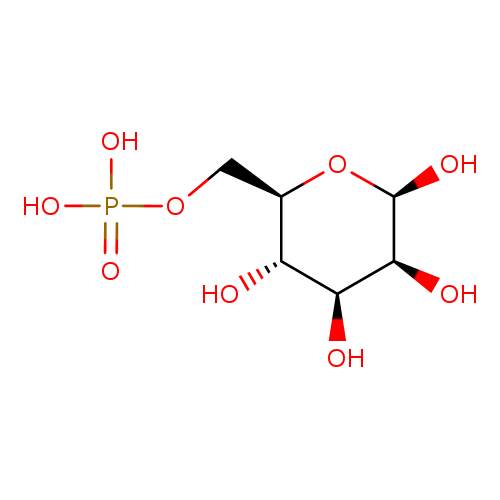
Mannose 6-phosphate, also known as alpha-D-mannose-6-p or mannose 6-phosphate, belongs to the class of organic compounds known as hexose phosphates. These are carbohydrate derivatives containing a hexose substituted by one or more phosphate groups. Mannose 6-phosphate is possibly soluble (in water) and an extremely weak basic (essentially neutral) compound (based on its pKa). Mannose 6-phosphate exists in all eukaryotes, ranging from yeast to humans. Mannose 6-phosphate participates in a number of enzymatic reactions, within cattle. In particular, Mannose 6-phosphate can be converted into fructose 6-phosphate; which is catalyzed by the enzyme mannose 6-phosphate isomerase. In addition, Mannose 6-phosphate can be biosynthesized from D-mannose through the action of the enzyme hexokinase-1. In cattle, mannose 6-phosphate is involved in the metabolic pathway called the fructose and mannose degradation pathway.
belongs to the class of organic compounds known as hexose phosphates. These are carbohydrate derivatives containing a hexose substituted by one or more phosphate groups.
Pascual, C.; Herrera, L. Use of permeabilized yeast cells as a system of enzyme immobilization. Its use for the preparation of mannose 6-phosphate. Folia Microbiologica (Prague, Czech Republic) (1981), 26(2), 103-6.
Catalyzes the phosphorylation of various hexoses, such as D-glucose, D-glucosamine, D-fructose, D-mannose and 2-deoxy-D-glucose, to hexose 6-phosphate (D-glucose 6-phosphate, D-glucosamine 6-phosphate, D-fructose 6-phosphate, D-mannose 6-phosphate and 2-deoxy-D-glucose 6-phosphate, respectively). Does not phosphorylate N-acetyl-D-glucosamine (By similarity). Mediates the initial step of glycolysis by catalyzing phosphorylation of D-glucose to D-glucose 6-phosphate (By similarity). Involved in innate immunity and inflammation by acting as a pattern recognition receptor for bacterial peptidoglycan. When released in the cytosol, N-acetyl-D-glucosamine component of bacterial peptidoglycan inhibits the hexokinase activity of HK1 and causes its dissociation from mitochondrial outer membrane, thereby activating the NLRP3 inflammasome (By similarity).
Transport of phosphorylated lysosomal enzymes from the Golgi complex and the cell surface to lysosomes. Lysosomal enzymes bearing phosphomannosyl residues bind specifically to mannose-6-phosphate receptors in the Golgi apparatus and the resulting receptor-ligand complex is transported to an acidic prelyosomal compartment where the low pH mediates the dissociation of the complex.
Acts as a positive regulator of T-cell coactivation, by binding DPP4 (By similarity). Transport of phosphorylated lysosomal enzymes from the Golgi complex and the cell surface to lysosomes. Lysosomal enzymes bearing phosphomannosyl residues bind specifically to mannose-6-phosphate receptors in the Golgi apparatus and the resulting receptor-ligand complex is transported to an acidic prelyosomal compartment where the low pH mediates the dissociation of the complex. This receptor also binds IGF2.