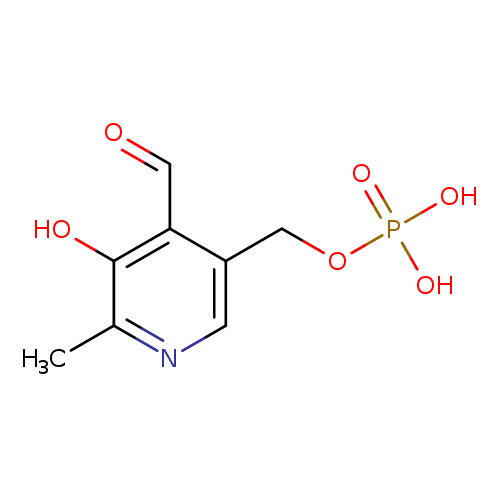
Pyridoxal 5'-phosphate, also known as phosphopyridoxal or PLP, belongs to the class of organic compounds known as pyridoxals and derivatives. Pyridoxals and derivatives are compounds containing a pyridoxal moiety, which consists of a pyridine ring substituted at positions 2,3,4, and 5 by a methyl group, a hydroxyl group, a carbaldehyde group, and a hydroxymethyl group, respectively. Pyridoxal 5'-phosphate is a drug which is used for nutritional supplementation and for treating dietary shortage or imbalance. Pyridoxal 5'-phosphate exists as a solid, possibly soluble (in water), and a strong basic compound (based on its pKa) molecule. Pyridoxal 5'-phosphate exists in all living species, ranging from bacteria to humans. In cattle, pyridoxal 5'-phosphate is involved in the metabolic pathway called the glycine and serine metabolism pathway. Pyridoxal 5'-phosphate is a potentially toxic compound. Pyridoxal 5'-phosphate has been found to be associated with several diseases known as rheumatoid arthritis, epilepsy, early-onset, vitamin b6-dependent, odontohypophosphatasia, and pyridoxamine 5-prime-phosphate oxidase deficiency; also pyridoxal 5'-phosphate has been linked to the inborn metabolic disorders including celiac disease.
belongs to the class of organic compounds known as pyridoxals and derivatives. Pyridoxals and derivatives are compounds containing a pyridoxal moiety, which consists of a pyridine ring substituted at positions 2,3,4, and 5 by a methyl group, a hydroxyl group, a carbaldehyde group, and a hydroxymethyl group, respectively.
In the winter and summer feeding experiments, plasma concentrations of vitamin B6 vitamers of pyridoxal (PL) and pyridoxal‐5′‐phosphate (PLP) with pyridoxic acid (PA), and homocysteine (Hcys) of the cows were assessed, along with their feed intake, milk production, rumen fermentation, and plasma metabolites.
Written in the paper as “pyridoxal‐5′‐phosphate” and “plasma”
Table 2Animal performances and plasma biochemical parameters in High versus Low residual feed intake (RFI) young bulls fed corn- or grass-silage diets.
Multicellular anatomical structure that consists of many cells of one or a few types, arranged in an extracellular matrix such that their long-range organisation is at least partly a repetition of their short-range organisation.
Plasma PLP concentration is considered to reflect the tissue concentration of PLP which is formed from PL by the phosphorylation enzyme or from the phosphorylated forms of PN and PM by the oxidase enzyme in the tissues (Parra et al. 2018).
Written in the paper as “pyridoxal‐5′‐phosphate” and “tissue”
Vitamin B6 is part of the vitamin B group and pyridoxal phosphate is the coenzyme form of this vitamin participating in the reactions related to the amino acid, glucose and lipid metabolism.
Written in the paper as “pyridoxal phosphate” and “amino acid metabolism”
A recent study suggested that PLP supplementation reduced the adverse effects and symptoms of COVID-19 by regulating immune responses, reducing proinflammatory cytokines, maintaining endothelial integrity, and preventing excessive coagulation [64].
Written in the paper as “Pyridoxal 5 -phosphate” and “excessive coagulation”
A programmed cell death characterized morphologically by the presence of smaller than normal mitochondria with condensed mitochondrial membrane densities, reduction or vanishing of mitochondria crista, and outer mitochondrial membrane rupture. Activation of mitochondrial voltage-dependent anion channels and mitogen-activated protein kinases, upregulation of endoplasmic reticulum stress, and inhibition of cystine/glutamate antiporter are involved in the induction of ferroptosis. This process is characterized by the accumulation of lipid peroxidation products and lethal reactive oxygen species (ROS) derived from iron metabolism. Glutathione peroxidase 4 (GPX4), heat shock protein beta-1, and nuclear factor erythroid 2-related factor 2 function as negative regulators of ferroptosis by limiting ROS production and reducing cellular iron uptake, respectively. In contrast, NADPH oxidase and p53 act as positive regulators of ferroptosis by promotion of ROS production and inhibition of expression of SLC7A11 (a specific light-chain subunit of the cystine/glutamate antiporter), respectively. Misregulated ferroptosis has been implicated in multiple physiological and pathological processes.
The chemical reactions and pathways involving glucose, the aldohexose gluco-hexose. D-glucose is dextrorotatory and is sometimes known as dextrose; it is an important source of energy for living organisms and is found free as well as combined in homo- and hetero-oligosaccharides and polysaccharides.
Vitamin B6 is part of the vitamin B group and pyridoxal phosphate is the coenzyme form of this vitamin participating in the reactions related to the amino acid, glucose and lipid metabolism.
Written in the paper as “pyridoxal phosphate” and “glucose metabolism”
A recent study suggested that PLP supplementation reduced the adverse effects and symptoms of COVID-19 by regulating immune responses, reducing proinflammatory cytokines, maintaining endothelial integrity, and preventing excessive coagulation [64].
Written in the paper as “Pyridoxal 5 -phosphate” and “immune responses”
The chemical reactions and pathways involving lipids, compounds soluble in an organic solvent but not, or sparingly, in an aqueous solvent. Includes fatty acids; neutral fats, other fatty-acid esters, and soaps; long-chain (fatty) alcohols and waxes; sphingoids and other long-chain bases; glycolipids, phospholipids and sphingolipids; and carotenes, polyprenols, sterols, terpenes and other isoprenoids.
Vitamin B6 is part of the vitamin B group and pyridoxal phosphate is the coenzyme form of this vitamin participating in the reactions related to the amino acid, glucose and lipid metabolism.
Written in the paper as “pyridoxal phosphate” and “lipid metabolism”
The chemical reactions and pathways involving any of the vitamin B6 compounds: pyridoxal, pyridoxamine and pyridoxine and the active form, pyridoxal phosphate.
Pyridoxal kinase (pdxK) is an essential enzyme in the terminal point of the vitamin B6 pathway which causes phosphorylation of pyridoxal to produce pyridoxal phosphate; therefore, a decreased expression of pdxK leads to vitamin B6 deficiency.
Written in the paper as “pyridoxal phosphate” and “vitamin B6 pathway”
A low-molecular-weight, non-protein organic compound participating in enzymatic reactions as dissociable acceptor or donor of chemical groups or electrons.
Vitamin B6 is part of the vitamin B group and pyridoxal phosphate is the coenzyme form of this vitamin participating in the reactions related to the amino acid, glucose and lipid metabolism.
Written in the paper as “pyridoxal phosphate” and “coenzyme”
An organic molecule or ion (usually a metal ion) that is required by an enzyme for its activity. It may be attached either loosely (coenzyme) or tightly (prosthetic group).
Catalyzes the synthesis of D-serine from L-serine. D-serine is a key coagonist with glutamate at NMDA receptors. Has dehydratase activity towards both L-serine and D-serine (By similarity).
Catalyzes the cleavage of serine to glycine accompanied with the production of 5,10-methylenetetrahydrofolate, an essential intermediate for purine biosynthesis. Serine provides the major source of folate one-carbon in cells by catalyzing the transfer of one carbon from serine to tetrahydrofolate. Contributes to the de novo mitochondrial thymidylate biosynthesis pathway via its role in glycine and tetrahydrofolate metabolism: thymidylate biosynthesis is required to prevent uracil accumulation in mtDNA. Also required for mitochondrial translation by producing 5,10-methylenetetrahydrofolate; 5,10-methylenetetrahydrofolate providing methyl donors to produce the taurinomethyluridine base at the wobble position of some mitochondrial tRNAs. Associates with mitochondrial DNA. In addition to its role in mitochondria, also plays a role in the deubiquitination of target proteins as component of the BRISC complex: required for IFNAR1 deubiquitination by the BRISC complex.
Serine palmitoyltransferase (SPT). The heterodimer formed with SPTLC2 or SPTLC3 constitutes the catalytic core. The composition of the serine palmitoyltransferase (SPT) complex determines the substrate preference. The SPTLC1-SPTLC2-SPTSSA complex shows a strong preference for C16-CoA substrate, while the SPTLC1-SPTLC3-SPTSSA isozyme uses both C14-CoA and C16-CoA as substrates, with a slight preference for C14-CoA. The SPTLC1-SPTLC2-SPTSSB complex shows a strong preference for C18-CoA substrate, while the SPTLC1-SPTLC3-SPTSSB isozyme displays an ability to use a broader range of acyl-CoAs, without apparent preference (By similarity). Required for adipocyte cell viability and metabolic homeostasis (By similarity).
Phosphorylase is an important allosteric enzyme in carbohydrate metabolism. Enzymes from different sources differ in their regulatory mechanisms and in their natural substrates. However, all known phosphorylases share catalytic and structural properties.
Protein serine phosphatase that dephosphorylates 'Ser-3' in cofilin and probably also dephosphorylates phospho-serine residues in DSTN. Regulates cofilin-dependent actin cytoskeleton reorganization. Required for normal progress through mitosis and normal cytokinesis. Does not dephosphorylate phospho-threonines in LIMK1. Does not dephosphorylate peptides containing phospho-tyrosine (PubMed:15580268). Pyridoxal phosphate (PLP) phosphatase, which also catalyzes the dephosphorylation of pyridoxine 5'-phosphate (PNP) and pyridoxamine 5'-phosphate (PMP), with order of substrate preference PLP > PNP > PMP (By similarity).
Catalyzes the reduction of N-oxygenated molecules, acting as a counterpart of cytochrome P450 and flavin-containing monooxygenases in metabolic cycles. As a component of prodrug-converting system, reduces a multitude of N-hydroxylated prodrugs particularly amidoximes, leading to increased drug bioavailability. May be involved in mitochondrial N(omega)-hydroxy-L-arginine (NOHA) reduction, regulating endogenous nitric oxide levels and biosynthesis. Postulated to cleave the N-OH bond of N-hydroxylated substrates in concert with electron transfer from NADH to cytochrome b5 reductase then to cytochrome b5, the ultimate electron donor that primes the active site for substrate reduction.
Phosphatase that has high activity toward pyridoxal 5'-phosphate (PLP). Also active at much lower level toward pyrophosphate, phosphoethanolamine (PEA), phosphocholine (PCho), phospho-l-tyrosine, fructose-6-phosphate, p-nitrophenyl phosphate, and h-glycerophosphate (By similarity).
Catalyzes the first reaction in the catabolism of the essential branched chain amino acids leucine, isoleucine, and valine. May also function as a transporter of branched chain alpha-keto acids (By similarity).
Transaminase with broad substrate specificity. Has transaminase activity towards aminoadipate, kynurenine, methionine and glutamate. Shows activity also towards tryptophan, aspartate and hydroxykynurenine. Accepts a variety of oxo-acids as amino-group acceptors, with a preference for 2-oxoglutarate, 2-oxocaproic acid, phenylpyruvate and alpha-oxo-gamma-methiol butyric acid. Can also use glyoxylate as amino-group acceptor (in vitro) (By similarity).
Biosynthesis of L-glutamate from L-aspartate or L-cysteine. Important regulator of levels of glutamate, the major excitatory neurotransmitter of the vertebrate central nervous system. Acts as a scavenger of glutamate in brain neuroprotection. The aspartate aminotransferase activity is involved in hepatic glucose synthesis during development and in adipocyte glyceroneogenesis. Using L-cysteine as substrate, regulates levels of mercaptopyruvate, an important source of hydrogen sulfide. Mercaptopyruvate is converted into H(2)S via the action of 3-mercaptopyruvate sulfurtransferase (3MST). Hydrogen sulfide is an important synaptic modulator and neuroprotectant in the brain (By similarity).
Catalyzes the irreversible transamination of the L-tryptophan metabolite L-kynurenine to form kynurenic acid (KA). Plays a key role in amino acid metabolism. Important for metabolite exchange between mitochondria and cytosol. Facilitates cellular uptake of long-chain free fatty acids (By similarity).
Catalyzes the conversion of gamma-aminobutyrate and L-beta-aminoisobutyrate to succinate semialdehyde and methylmalonate semialdehyde, respectively. Can also convert delta-aminovalerate and beta-alanine (By similarity).
Can metabolize asymmetric dimethylarginine (ADMA) via transamination to alpha-keto-delta-(NN-dimethylguanidino) valeric acid (DMGV). ADMA is a potent inhibitor of nitric-oxide (NO) synthase, and this activity provides mechanism through which the kidney regulates blood pressure (By similarity).
Catalyzes the last step in the trans-sulfuration pathway from methionine to cysteine. Has broad substrate specificity. Converts cystathionine to cysteine, ammonia and 2-oxobutanoate. Converts two cysteine molecules to lanthionine and hydrogen sulfide. Can also accept homocysteine as substrate. Specificity depends on the levels of the endogenous substrates. Generates the endogenous signaling molecule hydrogen sulfide (H2S), and so contributes to the regulation of blood pressure. Acts as a cysteine-protein sulfhydrase by mediating sulfhydration of target proteins: sulfhydration consists of converting -SH groups into -SSH on specific cysteine residues of target proteins such as GAPDH, PTPN1 and NF-kappa-B subunit RELA, thereby regulating their function (By similarity).
Catalyzes the reversible transamination between alanine and 2-oxoglutarate to form pyruvate and glutamate. Participates in cellular nitrogen metabolism and also in liver gluconeogenesis starting with precursors transported from skeletal muscles (By similarity).
Transaminase involved in tyrosine breakdown. Converts tyrosine to p-hydroxyphenylpyruvate. Can catalyze the reverse reaction, using glutamic acid, with 2-oxoglutarate as cosubstrate (in vitro). Has much lower affinity and transaminase activity for phenylalanine (By similarity).
Catalyzes the irreversible transamination of the L-tryptophan metabolite L-kynurenine to form kynurenic acid (KA). May catalyze the beta-elimination of S-conjugates and Se-conjugates of L-(seleno)cysteine, resulting in the cleavage of the C-S or C-Se bond (By similarity). Has transaminase activity towards L-kynurenine, tryptophan, phenylalanine, serine, cysteine, methionine, histidine, glutamine and asparagine with glyoxylate as an amino group acceptor (in vitro). Has lower activity with 2-oxoglutarate as amino group acceptor (in vitro) (By similarity).
Catalyzes the first and rate-limiting step of polyamine biosynthesis that converts ornithine into putrescine, which is the precursor for the polyamines, spermidine and spermine. Polyamines are essential for cell proliferation and are implicated in cellular processes, ranging from DNA replication to apoptosis.
Glycogen phosphorylase that regulates glycogen mobilization. Phosphorylase is an important allosteric enzyme in carbohydrate metabolism. Enzymes from different sources differ in their regulatory mechanisms and in their natural substrates. However, all known phosphorylases share catalytic and structural properties.
Phosphorylase is an important allosteric enzyme in carbohydrate metabolism. Enzymes from different sources differ in their regulatory mechanisms and in their natural substrates. However, all known phosphorylases share catalytic and structural properties (By similarity).
Phosphorylase is an important allosteric enzyme in carbohydrate metabolism. Enzymes from different sources differ in their regulatory mechanisms and in their natural substrates. However, all known phosphorylases share catalytic and structural properties.
Sulfurates the molybdenum cofactor. Sulfation of molybdenum is essential for xanthine dehydrogenase (XDH) and aldehyde oxidase (ADO) enzymes in which molybdenum cofactor is liganded by 1 oxygen and 1 sulfur atom in active form.